Have you ever stopped to think about how many words in English start with the letter P? From everyday items like pen and phone to bigger concepts like peace and power, the letter P is everywhere in our daily conversation and everyday use. If you’re an English learner, an ESL student, or just curious about words, this is a fun place to start.
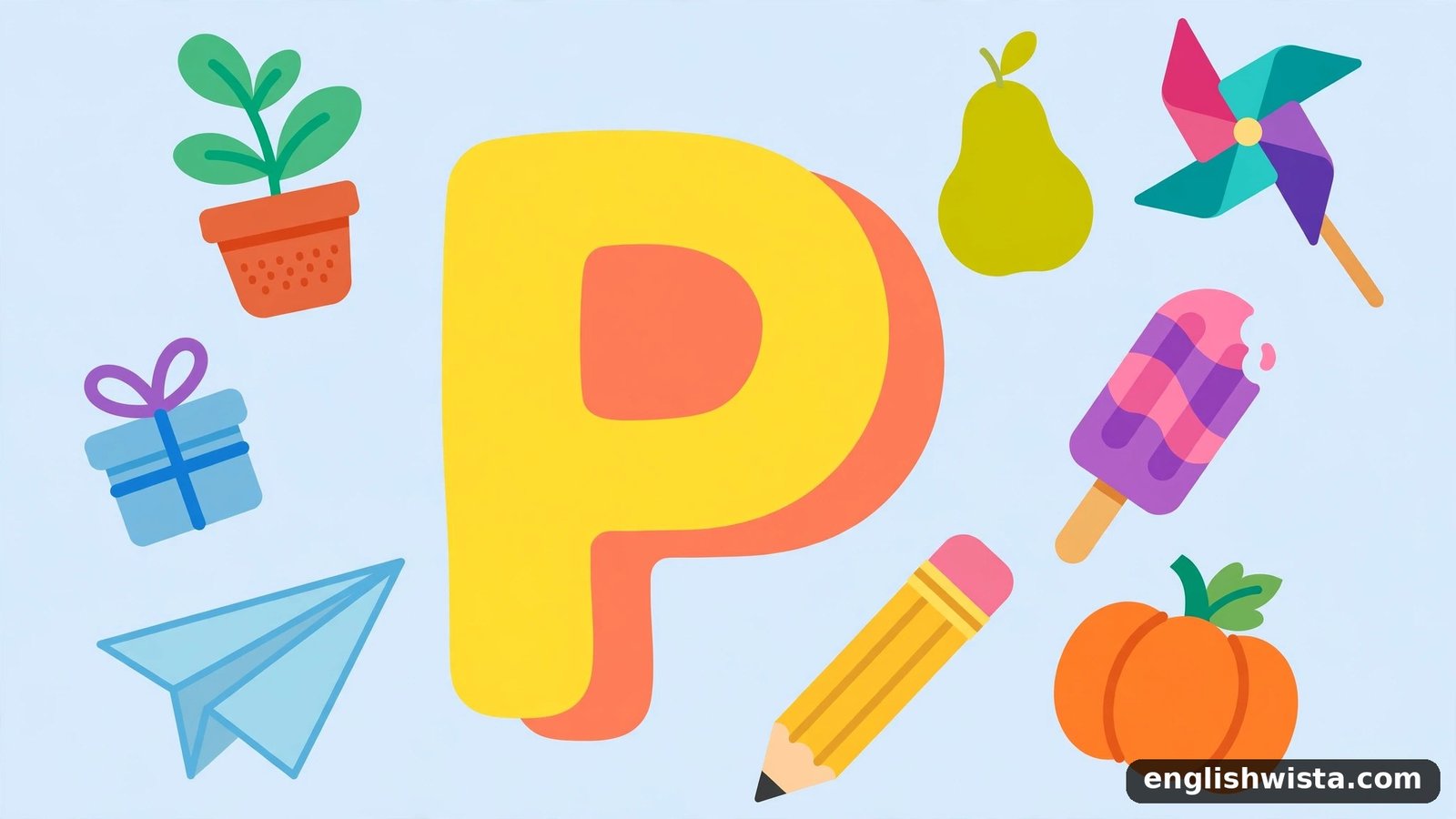
In this article, we’re going to explore nouns that start with P. We’ll talk about what nouns are, look at plenty of definitions and examples, and explain them in simple, easy-to-follow steps. Don’t worry this won’t feel like a boring grammar lesson. Instead, think of it as a friendly chat where we discover words together.
By the end, you’ll not only recognize lots of nouns that begin with P, but you’ll also feel more confident about using them in example sentences of your own. Let’s dive in!
What Is a Noun?
Before we get into the P words, let’s quickly remind ourselves what a noun is.
A noun is simply a word that names a person, place, thing, or idea. That’s it.
Here are some quick examples:
- Person: parent
- Place: park
- Thing: pencil
- Idea: patience
So when we talk about nouns starting with P, we’re really just looking for words that name people, places, things, or ideas and they all start with the letter P.
Why Focus on the Letter P?
The English alphabet has 26 letters, but some letters get used more often than others. P is a popular one. Many common, everyday nouns start with P. This makes it a great letter to study.
Plus, practicing with P words helps you expand your vocabulary in a fun and memorable way — a great vocabulary building habit for kids and grown-ups alike. When you see or hear them in daily life, you’ll remember this guide!
People Nouns That Start With P
Let’s begin with common nouns that describe people. These can be roles, jobs, or even relationships.
Some examples are:
- Parent – Your mother or father.
- Pilot – A person who flies an airplane.
- Poet – Someone who writes poems.
- Police officer – A person who maintains law and order.
- Player – Someone who takes part in a game or sport.
Example Sentences
- My parent is helping me with my homework.
- The pilot greeted the passengers before takeoff.
- A poet often sees the world in a creative way.
- The police officer helped the lost child.
- Every player in the team gave their best effort.
Notice how all these words clearly name a person or role.
Place Nouns That Start With P
Next, let’s look at places. These can be small or large, real or imaginary.
Examples include:
- Park – A public area with trees and grass where people relax.
- Palace – A very large and fancy home, often for royalty.
- Port – A harbor where ships dock.
- Planet – A large body in space, like Earth or Mars.
- Prison – A place where people are kept as punishment.
Example Sentences
- We had a picnic in the park.
- The king lived in a grand palace.
- The ship arrived at the port on time.
- Earth is the only known planet with life.
- The prison has strict security.
Thing Nouns That Start With P
Now for the fun part things! These are objects we use, see, or touch every day.
Examples:
- Pen – A tool for writing.
- Pencil – Another writing tool, but erasable.
- Paper – A thin sheet used for writing or printing.
- Phone – A device for calling or messaging.
- Plate – A dish used to serve food.
Example Sentences
- I wrote my name with a blue pen.
- The drawing was done with a pencil.
- Please hand me a piece of paper.
- She called her friend on the phone.
- The pasta was served on a large plate.
Idea Nouns That Start With P
Not all nouns are physical. Some name ideas or feelings — including positive nouns like peace and patience, which are wonderful positive words to know. These are sometimes called abstract nouns.
Examples:
- Peace – A state of calm and no conflict.
- Patience – The ability to stay calm while waiting.
- Pride – A sense of satisfaction or confidence.
- Power – The ability to control or influence.
- Pleasure – A feeling of happiness or enjoyment.
Example Sentences
- The world needs peace more than ever.
- She waited with great patience.
- He felt pride after winning the award.
- Knowledge is a form of power.
- It’s a pleasure to meet you.
Common Questions About P Nouns
Is “Pen” Singular or Plural?
“Pen” is singular. If you have more than one, you say “pens.”
- Singular: I have one pen.
- Plural: I have three pens.
What Is the Origin of “Phone”?
The word “phone” comes from the Greek word phōnē, which means “voice” or “sound.” That makes sense, right? A phone is all about sending sound.
Is “People” a Singular or Plural Noun?
This one is tricky! People is usually plural, meaning more than one person. But sometimes, in special contexts, it can mean a nation or community, and then it’s treated as singular.
- Plural: Many people are waiting in line.
- Singular (rare use): The Japanese are a peaceful people.
Expanding Your Vocabulary with P Nouns
Let’s make a quick list of even more nouns that start with P. This will give you more practice and ideas.
- Package
- Painting
- Piano
- Plant
- Prize
- Problem
- Project
- Pumpkin
- Puppy
- Puzzle
Try using them in your own sentences. For example:
- The package arrived at my house this morning.
- She plays the piano beautifully.
- We decorated the house with a big pumpkin.
Fun Facts About Nouns That Start With P
Here are some extra details to keep things interesting:
- The letter P is the 16th letter of the English alphabet. When it comes to letter sounds, P is an easy one: it makes a crisp /p/ sound, as in pen and park.
- In English, “P” is sometimes silent, like in the word psychology but that’s not a noun. For nouns, one example is pneumonia.
- Collective noun with P: A group of penguins on land is called a “waddle of penguins.” Cute, right?
- Some nouns starting with P also double as verbs, like paint (noun: a can of paint, verb: to paint a picture).
Practice Activity: Spot the P Nouns
Here’s a fun mini exercise for you — perfect for students and teachers looking for a quick classroom warm-up. Read the sentences and try to pick out the nouns starting with P:
- The puppy played in the park.
- She received a prize for her project.
- A painter used a pencil to sketch before adding paint.
Did you find them all? Great job!
Why Learning P Nouns Matters
You might wonder, “Why spend time on just one letter?” Here’s why:
- It’s easier to remember words when you learn them in groups.
- Knowing many nouns starting with P improves your speaking and writing.
- It helps you recognize patterns in English, like how plurals usually end with -s — a handy first step into the parts of speech.
The more familiar you are with these words, the more natural your English will feel.
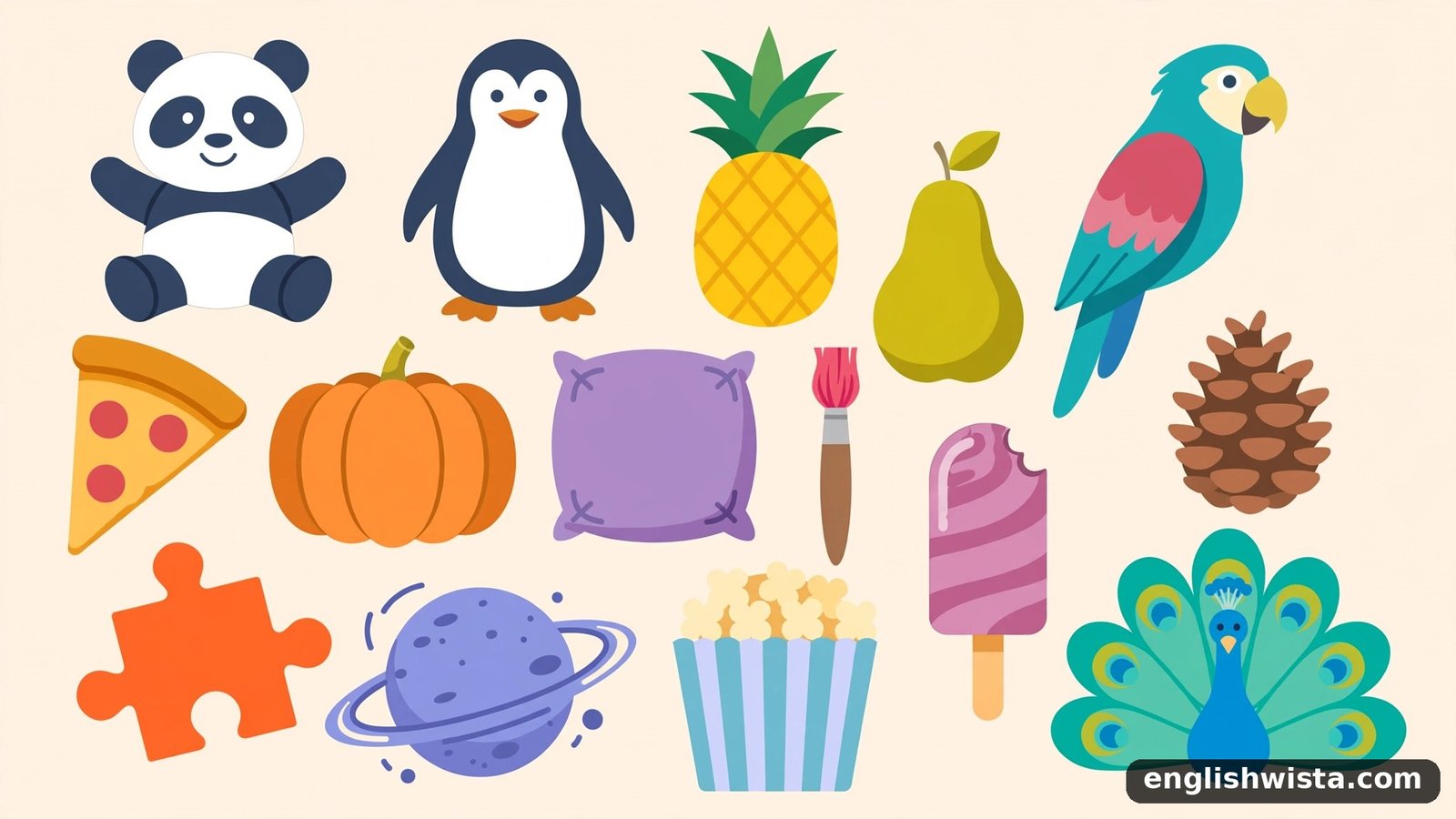
Noun Types Explained: Common, Proper, Abstract, and Concrete Nouns That Start with P
Not all P nouns work the same way. A common noun names a general person, place, thing, or idea and starts with a lowercase letter — like parent, park, phone, and peace. A proper noun names one specific person, place, or brand and always starts with a capital letter — think Paris, Pakistan, Paul, or Pixar. A concrete noun is something you can touch, see, or hear — like piano, pumpkin, pencil, and plate. An abstract noun names an idea or feeling you can’t touch — like patience, pride, power, and pleasure. Notice that a word can belong to two groups at once: peace is both a common noun and an abstract noun, while piano is a common noun and a concrete noun. Knowing these types makes the parts of speech much easier to master.
Conclusion
We’ve taken a long, friendly walk through nouns that start with P. Along the way, we:
- Reviewed what nouns are.
- Looked at nouns for people, places, things, and ideas.
- Learned real-life examples in sentences.
- Answered common questions and explored fun facts.
Now you know that nouns like pen, park, peace, player, and puppy are not just vocabulary words they’re tools to express yourself more clearly.
So next time you see something starting with P, think: “Is that a noun?” Chances are, it just might be. Keep practicing, keep playing with words, and you’ll keep improving.
Remember: Learning doesn’t have to be complicated. Just take it one step, one letter, and one word at a time. And today, you mastered the wonderful world of nouns starting with P.
Frequently Asked Questions
What are nouns that start with P?
Nouns that start with P are naming words that begin with the letter P. They can name people (parent, pilot), places (park, palace), things (pen, phone, piano), or ideas (peace, patience, power). The full word list in this article gives you dozens of definitions and examples you can start using today.
What are 10 common nouns that start with P?
Ten common nouns that start with P are pen, pencil, paper, park, piano, parent, pilot, pumpkin, puppy, and plate. Each one names a general person, place, or thing, so they are all written with a lowercase letter. Try writing one example sentence for each to lock them into your everyday use.
What are some positive nouns that start with P?
Positive nouns that start with P include peace, patience, pride, pleasure, prosperity, passion, praise, perseverance, positivity, and potential. These positive words are great for compliments, motivational writing, and daily conversation. Using them often is an easy vocabulary building habit.
What are some nouns that start with P for kids?
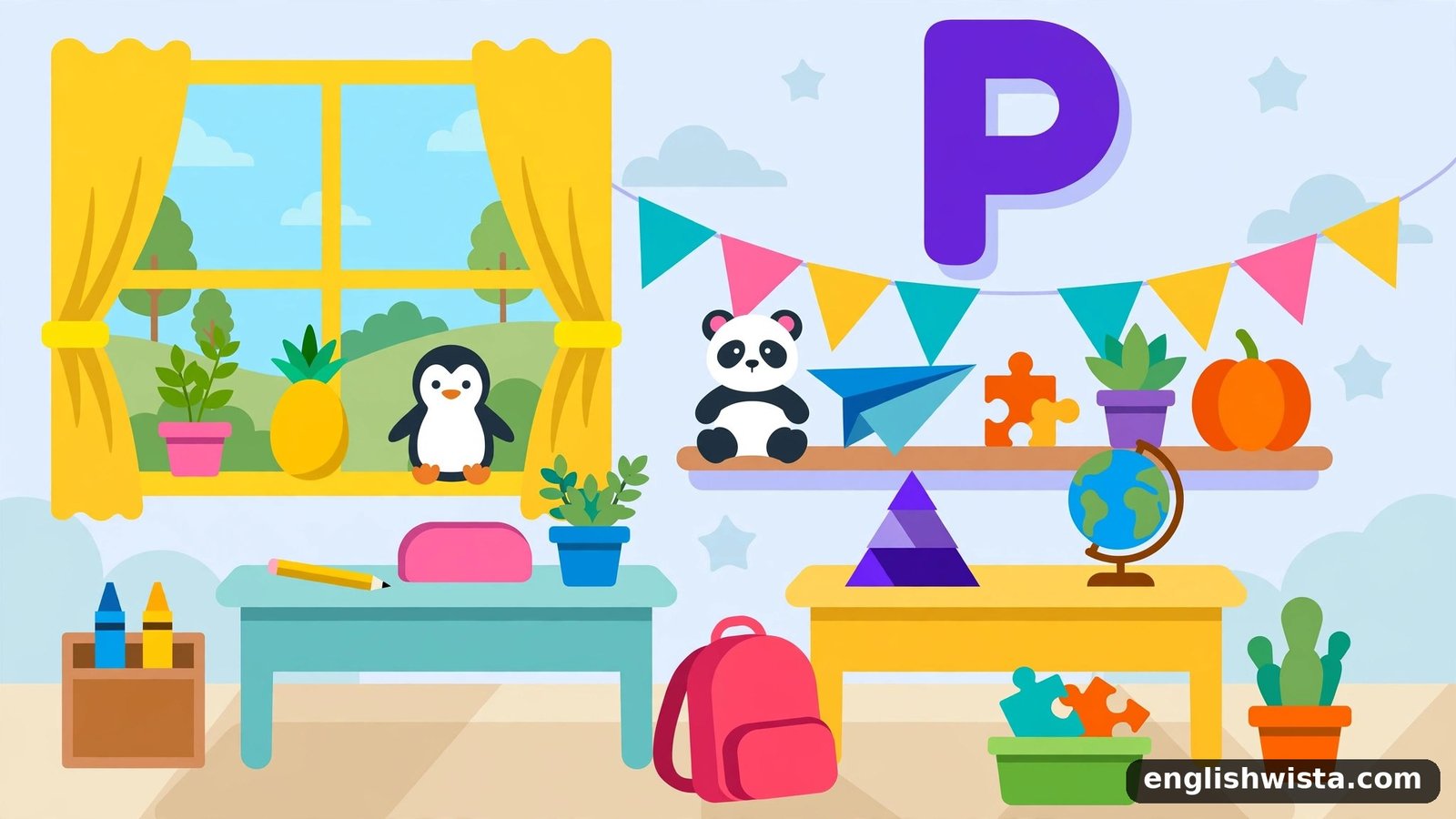
Easy P nouns for kids include pen, park, puppy, pumpkin, piano, pizza, panda, playground, paint, and puzzle. These simple, concrete words are perfect for preschool and kindergarten picture-vocabulary games. Point at the picture, say the word out loud, and have your child repeat it — a classic ESL-friendly routine.
How do you pronounce words that start with P?
Most words starting with P begin with a crisp /p/ sound, like in pen, park, and puppy — press your lips together and release a small puff of air. The common exception is a silent P before N, as in pneumonia (pronounced “new-MOH-nyuh”). English learners sometimes mix up /p/ and /b/, so practice pairs like pen–ben and park–bark to hear the difference.