Have you ever stood in the grocery store, looked at a bunch of shiny red tomatoes, and thought for a second: “Wait… is it tomatos or tomatoes?” Don’t worry, you’re not alone. Many people pause when writing or saying the plural of tomato because English spelling rules can be tricky. Even native speakers sometimes get confused.
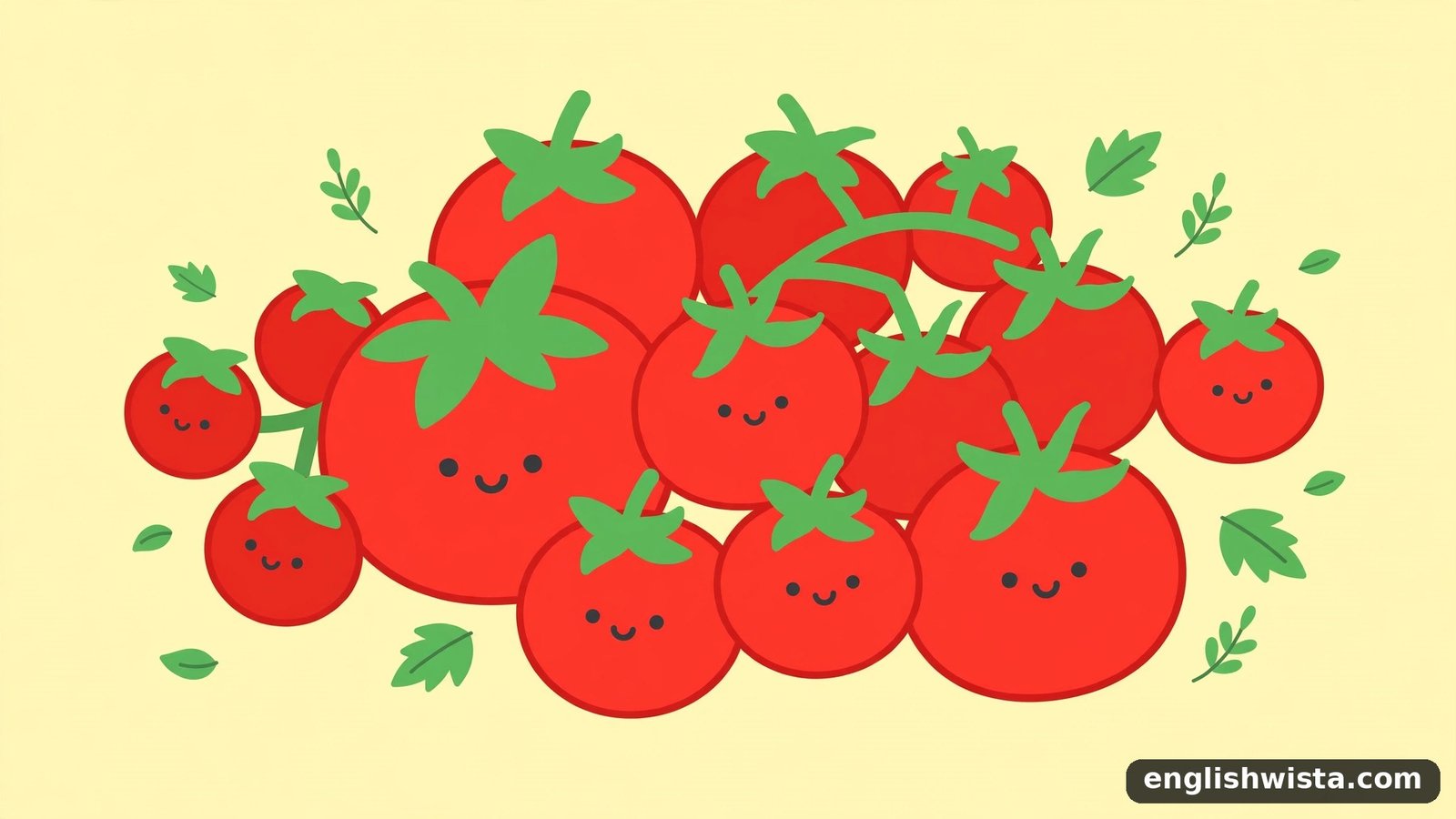
In this article, we’re going to make it super easy to understand. We’ll walk step by step through what the plural of tomato is, why it looks the way it does, and how to use it correctly in real life. Along the way, we’ll add examples, answer common questions, and even share some fun facts about the word. Think of this as your friendly guide to never second-guessing yourself when it comes to the word tomato.
Let’s take a closer look.
What is the Plural of Tomato?
The correct plural form of tomato is tomatoes — that’s the dictionary-recognized spelling, listed first in Merriam-Webster.
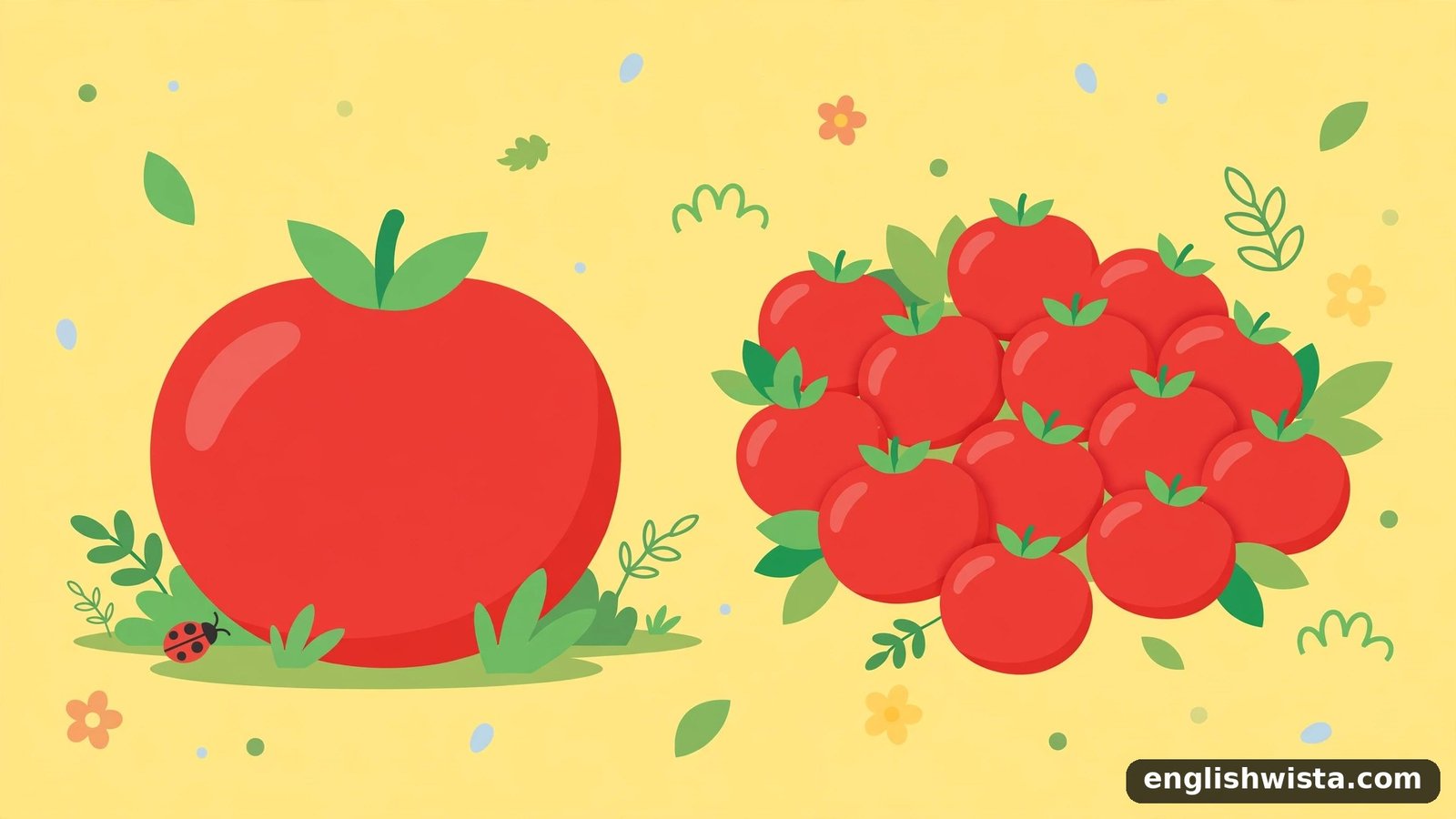
It’s as simple as that. When you’re talking about just one, you say a tomato. But when you’re talking about more than one, you switch to tomatoes — a classic singular vs plural pair.
- One tomato
- Two tomatoes
Notice that the plural is not tomatos. The letter -o at the end changes into -oes when we add the plural ending.
Why is it Tomatoes and Not Tomatos?
Good question! English has some patterns that explain this. Most of the time, when a word ends in -o, we simply add -s to make it plural (like piano → pianos). But with certain words, especially those that come from other languages or are older in English, the rule is a little different.
For these words, when you add the plural, you use -es instead of just -s. Tomato falls into this group. That’s why it becomes tomatoes.
Here are a few more examples of this pattern:
- Potato → Potatoes
- Hero → Heroes
- Echo → Echoes
So when in doubt, remember that tomato follows the same rule as potato and hero.
Is Tomato Singular or Plural?
The word tomato is singular. It means only one. If you want to talk about more than one, you use the plural form tomatoes.
- Singular: This tomato is ripe.
- Plural: These tomatoes are fresh.
Example Sentences Using Tomato and Tomatoes
Seeing words in action always makes them easier to understand. Let’s look at some example sentences:
Singular (tomato):
- I bought a tomato for my sandwich.
- That tomato looks juicy.
- A tomato fell off the vine.
Plural (tomatoes):
- She added three tomatoes to the salad.
- Tomatoes grow best in warm weather.
- The market sells both green and red tomatoes.
By practicing this kind of usage in sentences, you’ll quickly get used to switching between singular and plural forms — and getting your subject-verb agreement right.
Does Anyone Use “Tomatos”?
You might see tomatos written sometimes, but that’s a mistake. It’s not considered correct English spelling. The correct spelling is always tomatoes when you mean more than one.
So if you’re writing an essay, cooking recipe, or even just a shopping list, always remember to add the -es.
Where Did the Word Tomato Come From?
Here’s something fun: the word tomato has traveled a long way before it reached English.
- It comes from the Spanish word tomate.
- That Spanish word came from the Nahuatl (Aztec) word tomatl.
So, the tomato didn’t just travel around the world as food it also carried its name across different languages. That’s one reason the spelling might feel a little unusual.
Comparing Tomato with Similar Words
Sometimes the best way to understand a word is to compare it with others.
Words ending in -o that add -es:
- Tomato → Tomatoes
- Potato → Potatoes
- Hero → Heroes
Words ending in -o that just add -s:
- Photo → Photos
- Piano → Pianos
- Radio → Radios
As you can see, there’s no single rule that works for all words. That’s why it’s important to memorize the tricky ones like tomato.

Common Mistakes with the Plural of Tomato
Let’s go over a few common mistakes people often make — and the incorrect forms to watch out for:
- Writing “tomatos” instead of “tomatoes.”
- Wrong: I bought tomatos.
- Correct: I bought tomatoes.
- Mixing singular and plural forms.
- Wrong: This tomatoes is red.
- Correct: This tomato is red.
- Using plural when singular is needed.
- Wrong: I need one tomatoes.
- Correct: I need one tomato.
How to Remember the Correct Plural
Here are a few simple memory tricks — each one works as a handy mnemonic:
- Think of tomato and potato as best friends. If you can remember potatoes, you’ll also remember tomatoes.
- Picture the -oes as a pair of tomatoes side by side. That little “e” makes it feel like there’s more than one.
- Repeat to yourself: “One tomato, many tomatoes.” Repetition helps lock it into your memory.
Fun Facts About Tomatoes
To keep things interesting, let’s throw in some extra tomato trivia!
- Tomatoes are actually fruits, not vegetables. Botanically speaking, they grow from the flower of the plant and have seeds.
- The debate over “Is a tomato a fruit or vegetable?” has been around for years. In fact, the U.S. Supreme Court ruled in 1893 that tomatoes should be considered vegetables for tax purposes.
- There are more than 10,000 varieties of tomatoes grown around the world.
- The largest tomato ever recorded weighed over 10 pounds!
- The plural of tomato tomatoes became even more famous thanks to the old saying, “You say tomato, I say tomahto,” which shows how pronunciation differs between regions.
Tomato in Everyday Expressions
The word tomato also pops up in some fun sayings or nicknames:
- Hot tomato – a slang term from the 1920s meaning someone attractive.
- Ketchup comes from tomatoes – so every time you ask for ketchup, you’re really enjoying a form of tomatoes!
- Tomato fight festivals – in Spain, the famous “La Tomatina” festival involves thousands of people throwing tomatoes at each other.
Practice Time: Can You Spot the Right Plural?
Here’s a quick exercise for you. Which sentences are correct?
- He bought two tomatos.
- She sliced three tomatoes for the pasta.
- That tomatoes looks rotten.
- I grew five tomatoes in my garden.
Answer: Sentences 2 and 4 are correct.
Quick Definition for Clarity
Tomato (noun): A red (sometimes yellow or green) fruit commonly used as food. Singular form is tomato. Plural form is tomatoes.
How to Pronounce Tomato and Tomatoes
Getting the spelling right is one thing, but saying it correctly matters too. Here is the singular vs plural side by side.
Singular: tomato — pronounced tuh-MAY-toh (IPA transcription: /təˈmeɪtoʊ/).
Plural: tomatoes — pronounced tuh-MAY-tohz (IPA transcription: /təˈmeɪtoʊz/).
The stress always falls on the second syllable, MAY. To form the plural, you simply add a buzzing “z” sound at the end — nothing else changes.
In British English, you will often hear tuh-MAH-toh and tuh-MAH-tohz, which is where the old “you say tomato, I say tomahto” joke comes from.
Practice tip: say “one tomato, two tomatoes” out loud three times, exaggerating that final “z” each time. Your mouth will soon remember what your eyes already know.
Frequently Asked Questions
What is the plural of tomato?
The plural of tomato is tomatoes. This is the only correct plural form in standard English — just add -es to the end. Whether you are writing a recipe, a shopping list, or a school essay, tomatoes is the spelling to use.
Is the spelling “tomatos” correct?
No — “tomatos” is not a real word in English. It is one of the most common incorrect forms people write by mistake. Both Merriam-Webster and the Oxford English Dictionary recognize only tomatoes as the correct spelling.
How do you pronounce the plural of tomato?
Say it as “tuh-MAY-tohz” — the stress falls on the second syllable, and the plural adds a buzzing “z” sound at the end. In IPA transcription, that is /təˈmeɪtoʊz/. British speakers often say “tuh-MAH-tohz,” which is where the old “tomahto” joke comes from.
Do I say “the tomatoes is” or “the tomatoes are”?
Say “the tomatoes are.” Because tomatoes is plural, the rule of subject-verb agreement requires a plural verb: “The tomatoes are ripe,” not “The tomatoes is ripe.” For one, use the singular: “The tomato is ripe.”
Recap and Key Takeaways
Let’s wrap everything up in a neat little package.
- The singular form is tomato.
- The plural form is tomatoes.
- Don’t write tomatos — that’s one of the most common incorrect forms.
- Tomato follows the same rule as potato and hero by adding -es to make the plural.
- Remember with practice and examples, using the correct form will become second nature.
Conclusion
So there you have it the mystery of the plural of tomato is solved. It’s not as tricky as it looks once you understand the simple rule: one tomato, many tomatoes. Next time you’re writing a shopping list, preparing a recipe, or just chatting about your favorite foods, you’ll know exactly which form to use.
English can sometimes feel complicated, especially with words like tomato that don’t follow the most common pattern. But with a little practice and some fun memory tricks, it becomes easy.
And remember whether you’re eating one tomato on a sandwich or a whole bowl of fresh garden tomatoes, you now know how to say it correctly. Pretty handy, right?