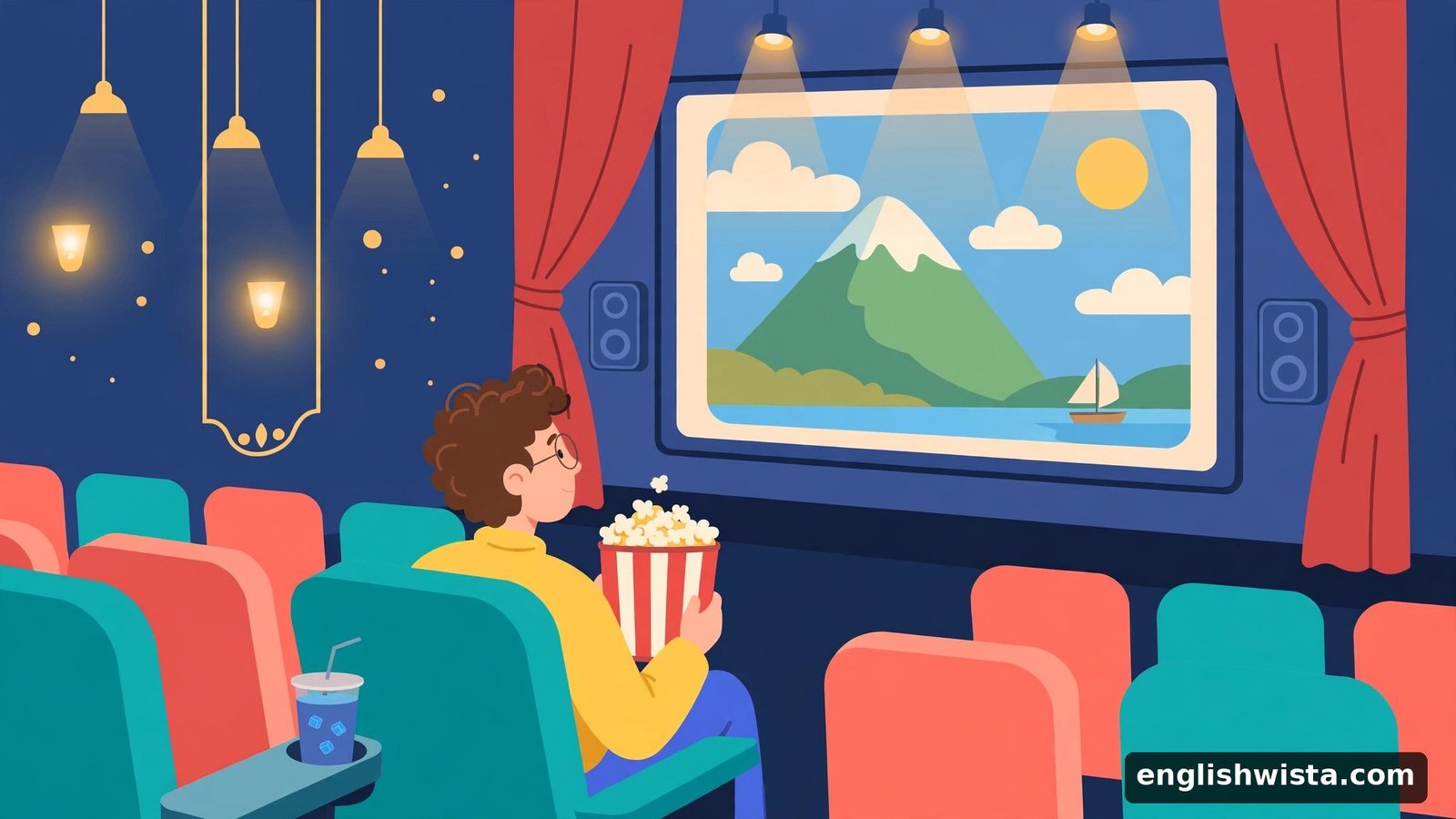
Do you ever write “watch” and wonder if it should be “see”? You are not alone! Your eyes do both jobs — but one is focused and the other is instant. Today, we will clear it up once and for all: watching is a movie; seeing is a snapshot.
What Is the Simple Difference?
Here is the short answer you can use almost every time:
- See = noticing with your eyes — passive and instant. (You see a bird fly past.)
- Watch = looking on purpose, for a while — active attention. (You watch a film.)
Think of it this way: seeing is a flash; watching is a stare.
See: Noticing
Use see when something enters your vision — no effort, often sudden, and usually for a short moment.
- I saw a rainbow this morning. (It appeared.)
- Can you see the mountain? (Is it visible?)
- She saw him across the street. (Sudden notice.)
- Did you see that? (A flash moment.)
If it appears before your eyes, it is see.
Watch: Focused Looking
Use watch when you look at something moving or changing, on purpose, for some time.
- We watched a movie last night. (Two hours of attention.)
- He watched the children play. (Sustained looking.)
- Watch the ball! (Focus on it!)
- She watches the news daily. (Regular focused viewing.)
If you keep your eyes on it, it is watch.
The Easy Trick to Remember
Here is a trick that never fails — the time test:
- Does it take time and attention? (A film, a game, a show) → watch.
- Is it a quick notice? (A flash, a glimpse, a sighting) → see.
Try it:
- “I saw a shooting star.” — a flash! Correct!
- “We watched the stars all night.” — hours of attention! Correct!
Flash = see. Stare = watch. That is the whole secret!
Watch vs See in Example Sentences
Let us look at real-life pairs side by side:
- I saw the match on TV. (Caught a glimpse.) / I watched the whole match. (Full attention.)
- She saw a cat in the garden. / She watched the cat climb the tree.
In each pair, see catches and watch follows.
Common Mistakes to Avoid
Mistake 1: “Watch” for a person you meet.
- Wrong: “I watched my friend yesterday.”
- Right: “I saw my friend yesterday.” (Meeting someone = see, unless you stalked them!)
Mistake 2: “See” for movies and shows.
- Loose: “I saw a great series.” (People say this!)
- Standard: “I watched a great series.” (A series takes time — watch is the precise choice. “Saw a film” is common in British English for cinema visits, though!)
Mistake 3: “Watch” for eyesight ability. “Can you see the board?” (ability) vs “Are you watching the board?” (attention). Different questions, like hear/listen!
Frequently Asked Questions
What is “look” then? The trio: see (passive), look (direct your eyes at something: “Look at this!”), watch (follow something over time). Look points; watch follows; see receives.
What about “see” for understanding? “I see what you mean” = I understand! This metaphorical see has nothing to do with eyes — it is about the mind’s eye.
Is “watch out” special? Yes — “Watch out!” = warning (“Watch out for the car!”). It means “be careful,” using watch’s attention sense.
How are they pronounced? See = “see”; watch = “woch” (the A sounds like “o” in “hot”).
Mini Quiz: Test Yourself
Choose watch or see for each sentence.
- 1. We _____ a brilliant film last night.
- 2. I _____ a fox in the garden this morning.
- 3. _____ out! There’s ice on the road.
- 4. She _____ her cousin at the mall.
- 5. The cat _____ the bird for ten minutes.
Answers: 1. watched (a film takes time) 2. saw (a flash sighting) 3. Watch (warning) 4. saw (met someone) 5. watched (sustained focus)
Quick Recap
- See = passive noticing, a flash.
- Watch = active, sustained attention.
- Time test: takes time = watch; instant = see.
- Meeting people = see; films/shows = watch.
- Trio: see (receive), look (point), watch (follow).
Conclusion
So, watch or see? Now you know: seeing is the flash of noticing, and watching is the steady gaze that follows. With the time test in your pocket, you will never mix them up again. Keep practicing with real sentences, and soon the right word will come to you automatically!