Do you ever write “set” and wonder if it should be “sit”? You are not alone! Like rise/raise and lie/lay, this pair hides a transitive/intransitive trap. Today, we will clear it up once and for all with the same simple question: who is sitting, and what is being placed?

What Is the Simple Difference?
Here is the short answer you can use almost every time:
- Sit = to be seated yourself — no object. (“Sit down.”)
- Set = to place something — needs an object. (“Set the book down.”)
Think of it this way: you sit on a chair; you set a cup on a table.
Sit: Seating Yourself
Use sit when the subject takes a seat — the body settles itself.
- Please sit down. (You sit yourself.)
- She sat by the window. (She seated herself.)
- The cat sits on the mat. (The cat, seated.)
- We sat for hours. (We, seated.)
If the subject is the sitter, it is sit.
Set: Placing Something
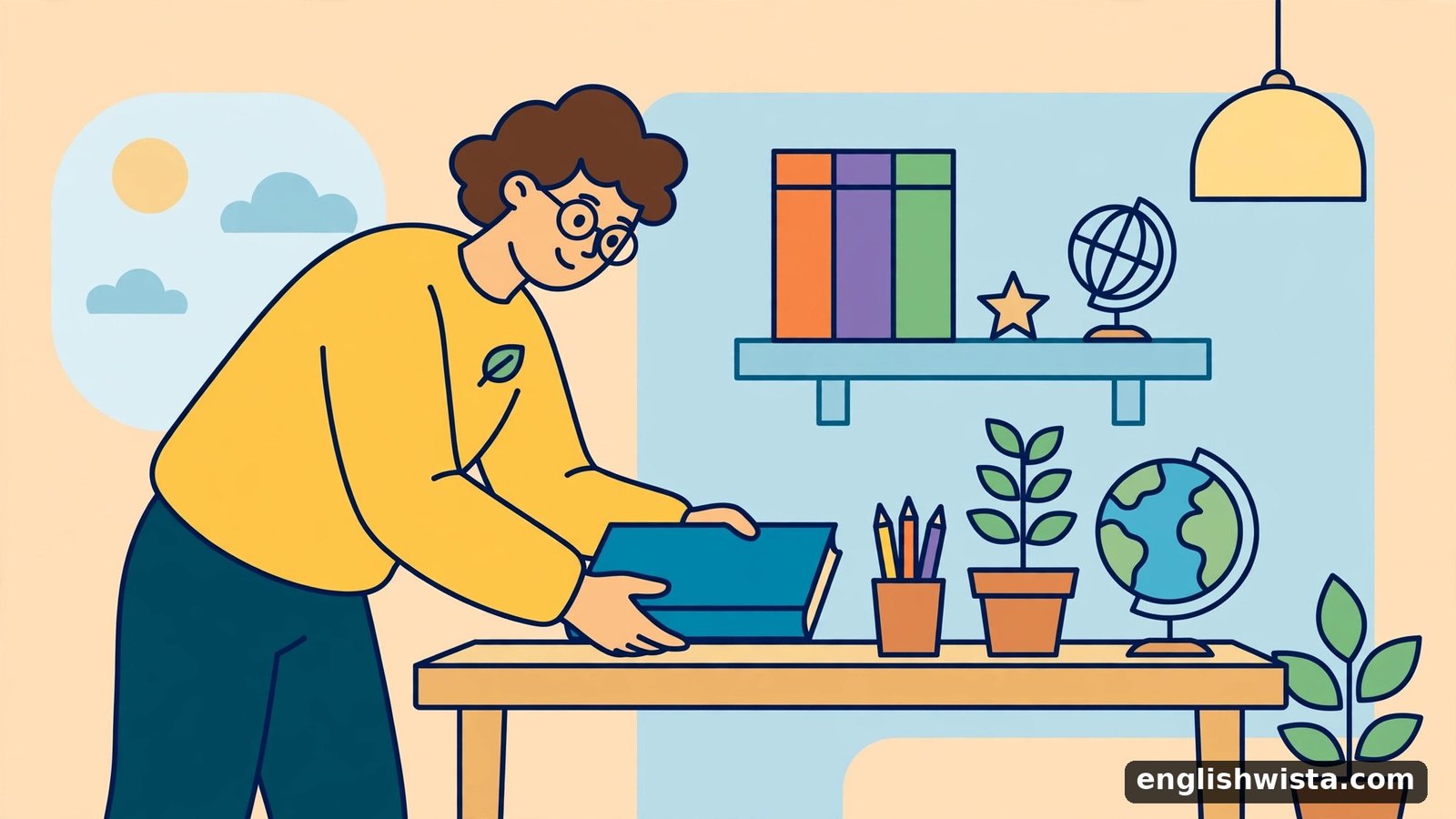
Use set when someone puts an object somewhere — an object always follows.
- Set the vase on the shelf. (Vase = object.)
- He set his bag down. (Bag = object.)
- She set the table for dinner. (Table = object — arranging!)
- They set a trap. (Trap = object.)
If something gets placed, it is set.
The Easy Trick to Remember
Here is a trick that never fails — the object test (same as rise/raise):
- Ask “set WHAT?” If you can answer with an object → set.
- If the sentence is complete without an object → sit.
Try it:
- “She ___ on the bench.” — no object → sat. Correct!
- “She ___ the box on the bench.” — box = object → set. Correct!
Object = set. No object = sit. That is the whole secret!
Sit vs Set in Example Sentences
Let us look at real-life pairs side by side:
- He sat on the chair. / He set his coat on the chair.
- The dog sits by the fire. / She sets a bowl by the fire.
In each pair, sit seats a body and set places a thing.
Common Mistakes to Avoid
Mistake 1: “Set” for yourself.
- Wrong: “Set down over here.”
- Right: “Sit down over here.” (You are seating yourself!)
Mistake 2: “Sit” with an object.
- Wrong: “Sit the book on the table.”
- Right: “Set the book on the table.” (Book = object!)
Mistake 3: Past forms confusion. Sit → sat → sat (“She has sat there”). Set → set → set (“He has set it down”). Set never changes — the laziest verb in English!
Frequently Asked Questions
What about “sit” for meetings and exams? “Sit an exam” (British: take an exam) and “sit for a portrait” — the sitter is the subject, still sit. No object placed, no set!
What is “set” in “set the sun”? Poetic exception: “The sun sets” means it goes down — the sun is the subject, and here “set” is intransitive. Idiom beats the rule here (and “sunset” is the noun!).
What about “set up” and “sit down”? Phrasal verbs follow the same logic: set up a business (place/establish something) vs sit down (seat yourself). The core verbs carry the meaning.
How are they pronounced? Sit = “sit” (short i); set = “set” (short e). Easy pair, tricky grammar!
Mini Quiz: Test Yourself
Choose sit or set for each sentence.
- 1. Please _____ down and relax.
- 2. _____ the plates on the table, please.
- 3. The baby _____ on the floor.
- 4. He _____ his phone beside the bed.
- 5. We _____ for the photo.
Answers: 1. sit (seat yourself) 2. Set (plates = object) 3. sits (the baby seats itself) 4. set (phone = object) 5. sat (we seated ourselves)
Quick Recap
- Sit = seat yourself, no object (sat, sat).
- Set = place something, needs object (set, set).
- Object test settles every case.
- Sunsets are the poetic exception (“the sun sets”).
- Same family as rise/raise and lie/lay.
Conclusion
So, sit or set? Now you know: sit seats a body, and set places a thing. With the object test in your pocket, you will never mix them up again. Keep practicing with real sentences, and soon the right word will come to you automatically!