Anyone and any one look almost the same on the page, but they work in different ways. One is a pronoun that means any person, and the other is a phrase that points to a single item or person from a group. Many learners mix them up because they sound identical. This simple guide will help you understand the difference with easy examples, a memory trick, and a mini quiz.

What Is the Simple Difference?
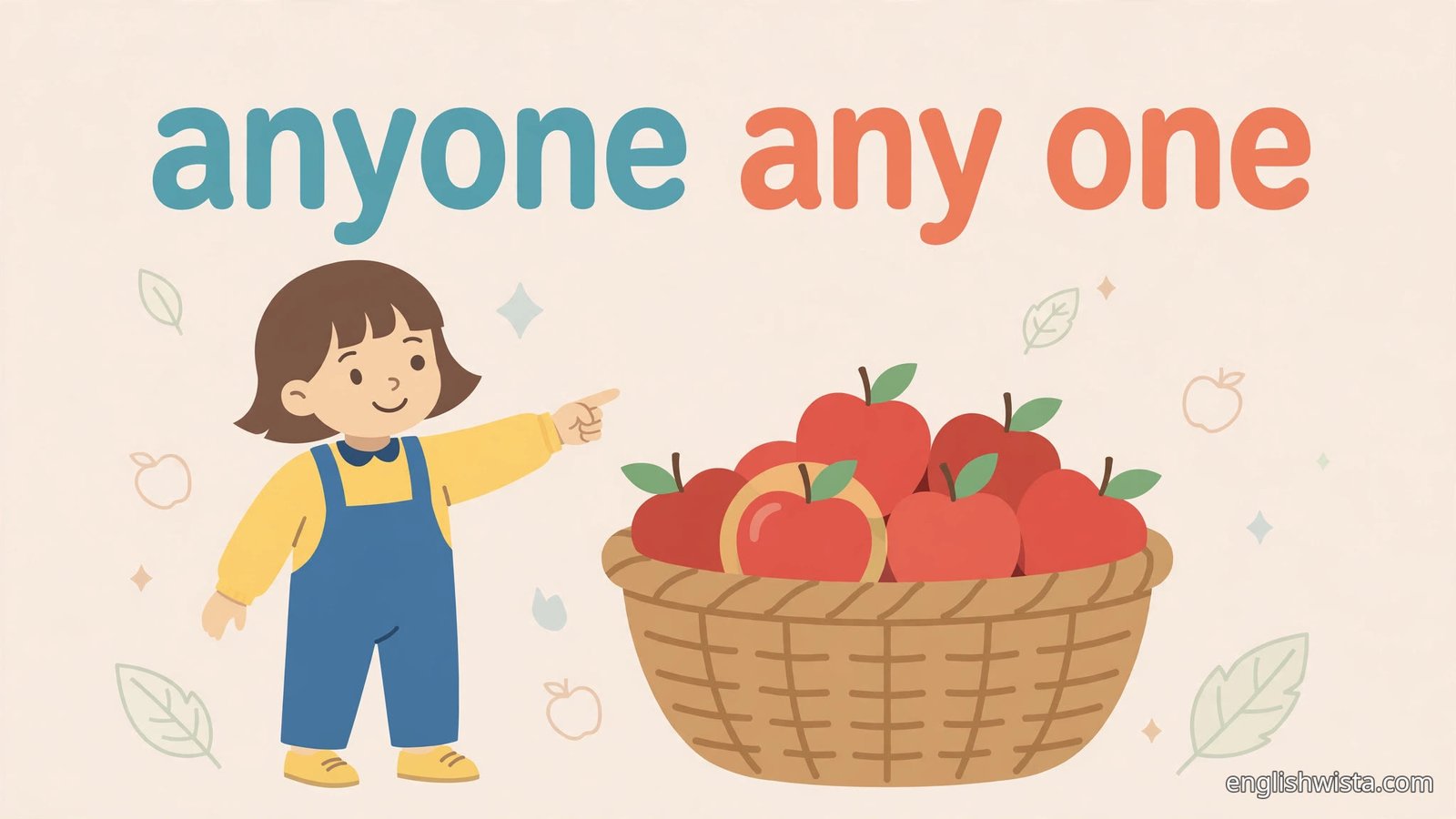
The simple difference is this: anyone (one word) means any person at all, while any one (two words) means any single item or person from a group. So when you ask if somebody has a pen, you ask if anyone has one. When you tell a friend to pick a single book from the shelf, you say pick any one. Remember: anyone is about people in general, any one is about one item from a group.
Anyone: The Any-Person Pronoun
Anyone is an indefinite pronoun that means any person, no matter who. It is the same as anybody. Use it in questions, negative sentences, and general statements about people.
- Does anyone know the answer?
- She did not tell anyone her secret.
- Anyone can learn to swim with practice.
Any One: The Single-Item Phrase
Any one is a phrase made of the determiner any plus the number one. It means any single person or thing from a group, and it is often followed by of. Use it when you are choosing one item out of several.
- You can choose any one of these three books.
- Any one of the students could win the prize.
- Pick any one — they all taste the same.
The Easy Trick to Remember
- Swap test with “any single”. If you can replace it with “any single”, write any one: “Pick any single book” works, so “Pick any one” is right.
- Swap test with “anybody”. If you can replace it with “anybody”, write anyone: “Does anybody know?” works, so “Does anyone know?” is right.
- Watch for “of”. The phrase any one of is always two words.
- Say it as a rhyme: “If it is a person, use anyone; if you pick just one, use any one.”
Example Pairs
- Anyone is welcome to join the club. / Any one of these shirts will suit you.
- Has anyone seen my keys? / Take any one of the seats by the window.
- She never speaks to anyone on the bus. / Any one of the runners could finish first.
Common Mistakes to Avoid
Wrong: Choose anyone of the two desserts.
Right: Choose any one of the two desserts.
Wrong: Any one can solve this easy puzzle.
Right: Anyone can solve this easy puzzle.
Wrong: Is any one at home?
Right: Is anyone at home?
Frequently Asked Questions
Is “anyone” the same as “anybody”? Yes. They mean exactly the same thing. “Anyone” is a little more formal, and “anybody” is a little more casual.
Can “any one” refer to a person? Yes, when you are choosing one person from a group: “Any one of you can answer.” The “of” shows you are picking from a group.
Why does “anyone” not take “of”? Because anyone is a single pronoun meaning any person in general, not one item chosen from a group. For “of”, use the two-word phrase: “any one of”.

Mini Quiz: Test Yourself
- 1. ___ can help — you do not need to be an expert.
- 2. You may take ___ of the free pens on the table.
- 3. Did ___ call while I was out?
- 4. ___ of the three answers is correct.
- 5. She did not invite ___ to her party.
Answers: 1. Anyone, 2. any one, 3. anyone, 4. Any one, 5. anyone.
Quick Recap
- Anyone = any person at all (same as anybody).
- Any one = any single item or person from a group (often followed by “of”).
- “Any single” fits any one; “anybody” fits anyone.
- The phrase “any one of” is always two words.
Conclusion
Now you know the simple difference: anyone means any person and any one means a single item from a group. Keep the swap test in mind, practice with the example sentences, and you will never mix up these two look-alike words again.