Awhile and a while sound exactly the same, but they are used in different places in a sentence. One is an adverb that means for a short time, and the other is a noun phrase that usually follows a preposition like for or in. Many learners mix them up because they are pronounced identically. This simple guide will help you understand the difference with easy examples, a memory trick, and a mini quiz.

What Is the Simple Difference?
The simple difference is this: awhile (one word) is an adverb that means for a short time, while a while (two words) is an article plus a noun that means a period of time. So when you ask a friend to wait a little, you say wait awhile. When you say you have not seen someone for a long period, you say for a while. Remember: awhile stands alone, a while follows a preposition.
Awhile: The Short-Time Adverb
Awhile is an adverb that means for a short time or for a little while. It stands alone after a verb and never follows a preposition. Note that awhile is more common in American English; many British speakers prefer for a while instead.
- Please sit down and rest awhile.
- We chatted awhile before the meeting started.
- Stay awhile — dinner is almost ready.
A While: The Time Noun Phrase
A while is made of the article a plus the noun while, which means a period of time. It almost always comes after a preposition such as for, in, or after.
- I have not seen him for a while.
- She will be back in a while.
- It took quite a while to finish the project.
The Easy Trick to Remember
- Check the word before it. If you see for, in, or after right before it, write a while: “for a while“.
- Awhile needs no helper. If there is no preposition and the word sits after a verb, write awhile: “rest awhile“.
- The for test. Try putting “for” in front. If “for ___” sounds right, you need a while — because “for awhile” is wrong.
- Say it as a rhyme: “Rest awhile, stay for a while — the preposition makes it worthwhile.”
Example Pairs
- Let us sit awhile and talk. / We have been talking for a while.
- Wait awhile before you call him. / I have not called him in a while.
- They rested awhile under the tree. / It was quite a while before they moved on.
Common Mistakes to Avoid
Wrong: I have not seen you for awhile.
Right: I have not seen you for a while.
Wrong: Sit down and rest a while.
Right: Sit down and rest awhile.
Wrong: She will return in awhile.
Right: She will return in a while.
Frequently Asked Questions
Is “for awhile” ever correct? No. “For” is a preposition, and awhile cannot follow a preposition. Always write “for a while“.
Is “awhile” American or British? Awhile is common in American English. British English usually uses “for a while” or “for a little while” instead.
Can “a while” be used without a preposition? Sometimes, with words like “quite” or “a long”: “It took quite a while.” But it never stands completely alone the way awhile does.

Mini Quiz: Test Yourself
- 1. Please wait ___ — I will be right back.
- 2. We have not met ___.
- 3. Stay ___ and have some tea.
- 4. She lived in London for ___.
- 5. Rest ___ before you continue working.
Answers: 1. awhile, 2. for a while, 3. awhile, 4. a while, 5. awhile.
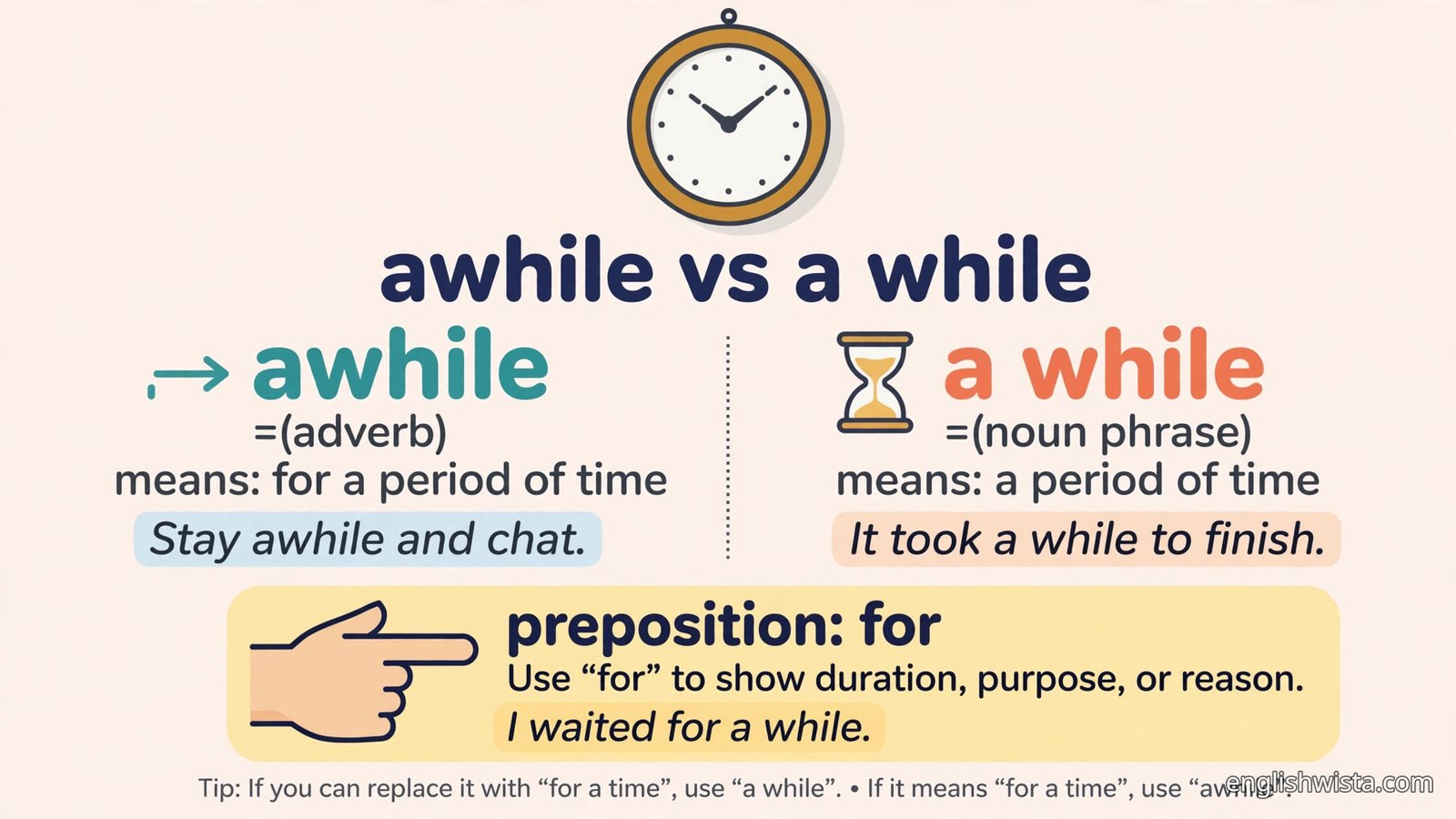
Quick Recap
- Awhile = for a short time (one word, an adverb, no preposition before it).
- A while = a period of time (two words, follows for, in, after, or quite).
- “For awhile” is always wrong — write “for a while“.
- Preposition before it means a while; no preposition means awhile.
Conclusion
Now you know the simple difference: awhile stands alone after a verb and a while follows a preposition. Keep the preposition test in mind, practice with the example sentences, and you will never mix up these two look-alike words again.