Cite, site, and sight sound exactly the same, but they have three very different meanings. One is about quoting, one is about a place, and one is about seeing. Mixing them up is easy, but this simple guide will help you tell them apart with easy examples, a memory trick, and a mini quiz.
What Is the Simple Difference?
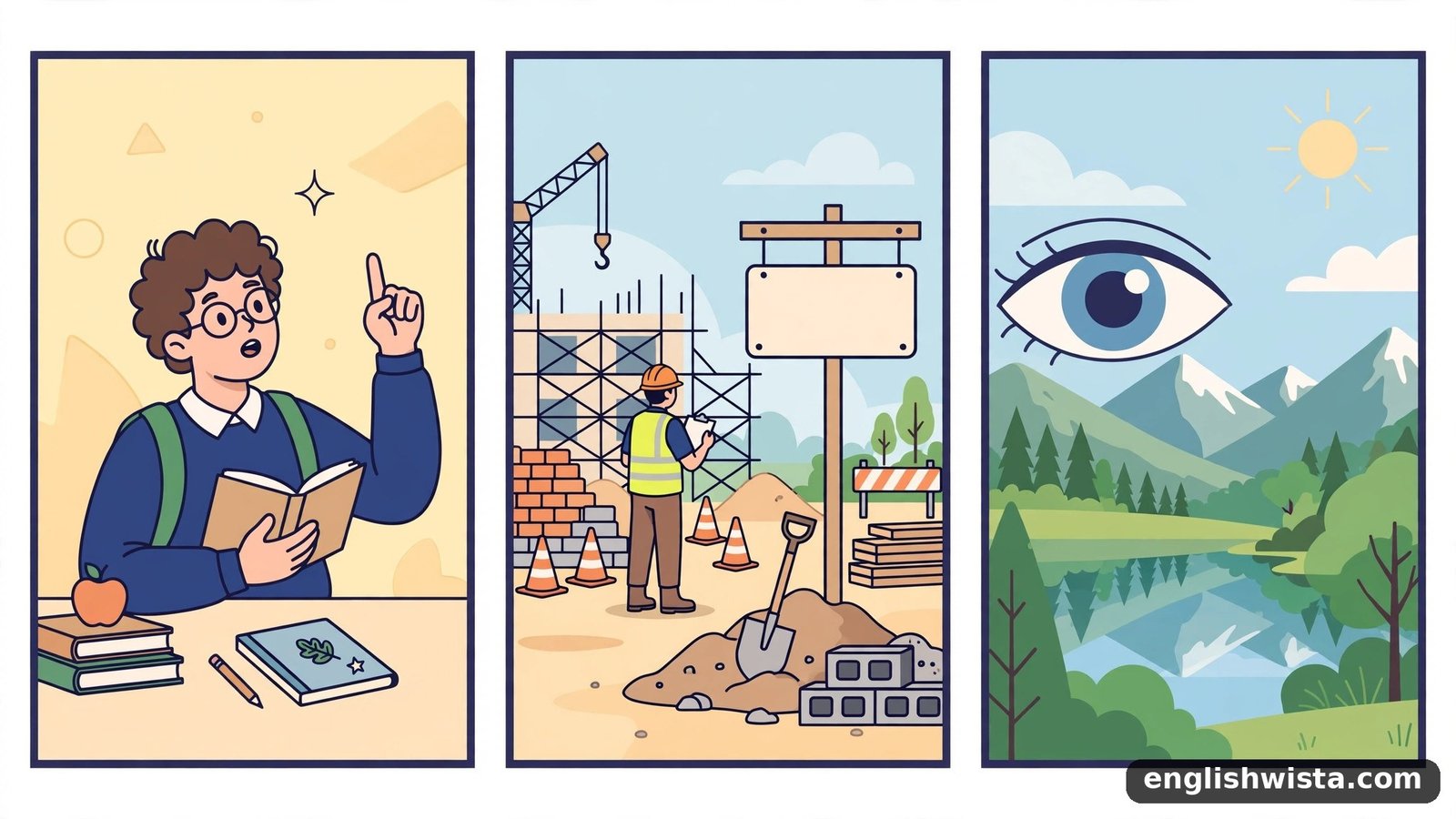
The simple difference is this: cite means to quote or mention something as proof, site means a place where something is or happens, and sight means the ability to see, or something you see. So you cite a source in your essay, you visit a building site, and you enjoy a beautiful sight.
Cite: The Quoting Word
Cite (pronounced “syte”) is a verb meaning to quote or mention something as evidence, or to refer to an official source. Writers cite books, teachers cite rules, and judges cite laws.
- Please cite your sources at the end of the essay.
- The teacher cited three examples from the textbook.
- He was cited for speeding by the police officer.
Site: The Place Word
Site (pronounced “syte”) is a noun meaning a place where something is, was, or will happen. A building site, a camp site, and a website are all places of a kind.
- The new school is being built on the old factory site.
- We visited the site of the famous battle.
- Workers wear helmets on the construction site.
Sight: The Seeing Word
Sight (pronounced “syte”) is a noun meaning the ability to see, or something that you see. It is also used in phrases like “out of sight” and “a sight for sore eyes”.
- Her sight is perfect — she does not need glasses.
- The sunset over the mountains was a beautiful sight.
- He lost sight of his friends in the crowd.
The Easy Trick to Remember
- Cite has a “c” — like “quote”. Both are about words and evidence.
- Site has a “t” — like “location”. Think of a place with a “t” in it, like “spot” or “plot”.
- Sight has “igh” — like “light” and “night”. Light is what your eyes need to see.
- Say it as a rhyme: “I cite the book at the site — what a lovely sight.”
Example Pairs
- Always cite your sources in an essay. / The library is on the same site as the old school. / A rainbow is a wonderful sight.
- She cited the rule from the handbook. / They chose a quiet site for the picnic. / His bad eyesight made reading hard — his sight was weak.
- The lawyer will cite the case in court. / The website is easy to use — a well-built site. / We caught sight of a deer in the forest.
Common Mistakes to Avoid
Wrong: Please site your sources in the report.
Right: Please cite your sources in the report.
Wrong: The building cite is closed today.
Right: The building site is closed today.
Wrong: The view was a beautiful cite.
Right: The view was a beautiful sight.
Frequently Asked Questions
Are cite, site, and sight homophones? Yes. All three are pronounced exactly the same — “syte” — but they are spelled differently and have different meanings.
Can “site” be a verb? Yes. To site something means to place it in a location, as in “The factory was sited near the river.”
What is the difference between “sight” and “site”? Sight is about seeing; site is about a place. A beautiful sight is something you see; a building site is a place where work happens.
Is “cite” related to “citation”? Yes. A citation is a formal mention of a source — the noun form of the verb cite.

Mini Quiz: Test Yourself
- 1. Please ___ your sources at the end of your essay.
- 2. The new hospital will be built on this ___.
- 3. The waterfall was a wonderful ___.
- 4. He lost ___ of the ball in the bright sun.
- 5. The teacher ___ three examples to prove her point.
Answers: 1. cite, 2. site, 3. sight, 4. sight, 5. cited.

Quick Recap
- Cite = to quote or mention as proof (think: “quote” — both about words).
- Site = a place where something happens (think: a spot or location).
- Sight = the ability to see, or something seen (think: “light” — what eyes need).
- All three sound the same — “syte” — but their spelling gives the meaning away.
Conclusion
Now you know the simple difference: cite is for quoting, site is for a place, and sight is for seeing. Keep the memory trick in mind, practice with the example sentences, and you will never mix up these three sound-alike words again.