Fair and fare sound exactly the same, but they mean very different things. One is about a carnival, something just and equal, or light-colored hair — and the other is the money you pay for a bus or taxi ride. This simple guide will clear up the confusion with easy examples, a memory trick, common mistakes, and a mini quiz.
What Is the Simple Difference?
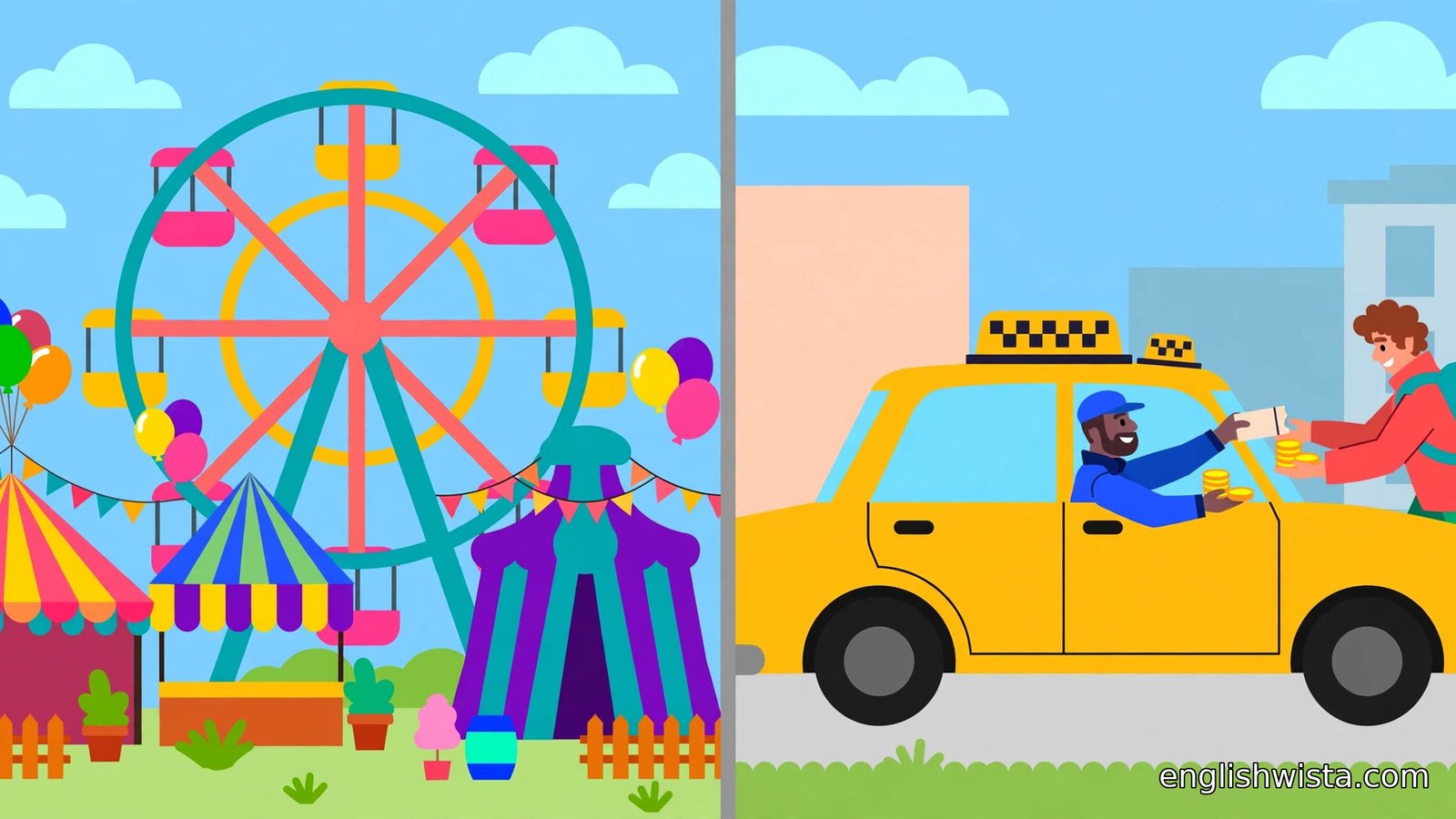
The simple difference is this: fair describes a carnival or festival, or means just and reasonable; fare is the price you pay to travel by bus, taxi, or train. So you enjoy the rides at a fair, and you pay the fare to get there. Remember: a fair is fun, a fare is a fee.
Fair: The Just and Carnival Word
Fair has two common uses. It can mean just, honest, and reasonable — treating people equally. It can also mean a public event with games, rides, and food, like a county fair. (It can also mean light in color, as in fair hair.)
- The teacher gave every student a fair chance to answer.
- We rode the giant ferris wheel at the county fair.
- It is not fair that he always gets the biggest piece of cake.
Fare: The Travel Price Word
Fare is the money you pay for a journey by bus, train, taxi, or airplane. It is always about the cost of travel — never about carnivals or justice.
- The bus fare to the city center is only two dollars.
- She could not afford the taxi fare to the airport.
- The train fare goes up every year.
The Easy Trick to Remember
- Fare rhymes with “care” — care about the money you pay for your trip.
- Fair has “air” — think of fresh outdoor air at a fun carnival fair.
- Think: “a fare is what you pay” — both words end in the same sound.
- If it is about a ride or a ticket price, you want the one with an “e” — fare.
Example Pairs
- The school judged the contest in a fair way. / The bus fare rose to three dollars this month.
- Children love the games at the summer fair. / He paid the taxi fare and thanked the driver.
- She has fair skin and green eyes. / The train fare includes a free cup of tea.
Common Mistakes to Avoid
Wrong: We had fun at the fare last weekend.
Right: We had fun at the fair last weekend.
Wrong: The bus fair is two dollars.
Right: The bus fare is two dollars.
Wrong: The referee must be fare to both teams.
Right: The referee must be fair to both teams.
Frequently Asked Questions
Are “fair” and “fare” pronounced the same? Yes. Both are pronounced like “fair”, so only the spelling and the meaning tell them apart.
Can “fair” mean anything else? Yes. It can also mean light in color (“fair hair”), or moderately good (“a fair attempt”). The carnival and justice meanings are the most common.
Is “fare” also food? In very formal or old-fashioned English, “fare” can mean food served at a meal. But today, it almost always means the price of travel.

Mini Quiz: Test Yourself
- 1. The judge gave a ___ decision to both sides.
- 2. The taxi ___ was higher than I expected.
- 3. We bought cotton candy at the county ___.
- 4. Students pay a lower train ___ with a discount card.
- 5. Everyone deserves a ___ chance to win.
Answers: 1. fair, 2. fare, 3. fair, 4. fare, 5. fair.

Quick Recap
- Fair = a carnival or festival; also means just, honest, or light-colored.
- Fare = the money you pay to travel by bus, train, taxi, or plane.
- Pronounced the same — only the spelling changes the meaning.
- Memory clue: fare with an “e” is what you pay to go somewhere.
Conclusion
Now you know the simple difference: a fair is fun and just, while a fare is the fee for your journey. Keep the memory trick handy, and you will always pick the right word — whether you are talking about a carnival or catching a bus.