Home and house are often used as if they mean the same thing, but they do not. A house is a building, while a home is a place filled with feeling, family, and belonging. You can buy a house in a day, but it takes time to make it a home. This simple guide will help you tell them apart with easy examples, a memory trick, and a mini quiz.
What Is the Simple Difference?
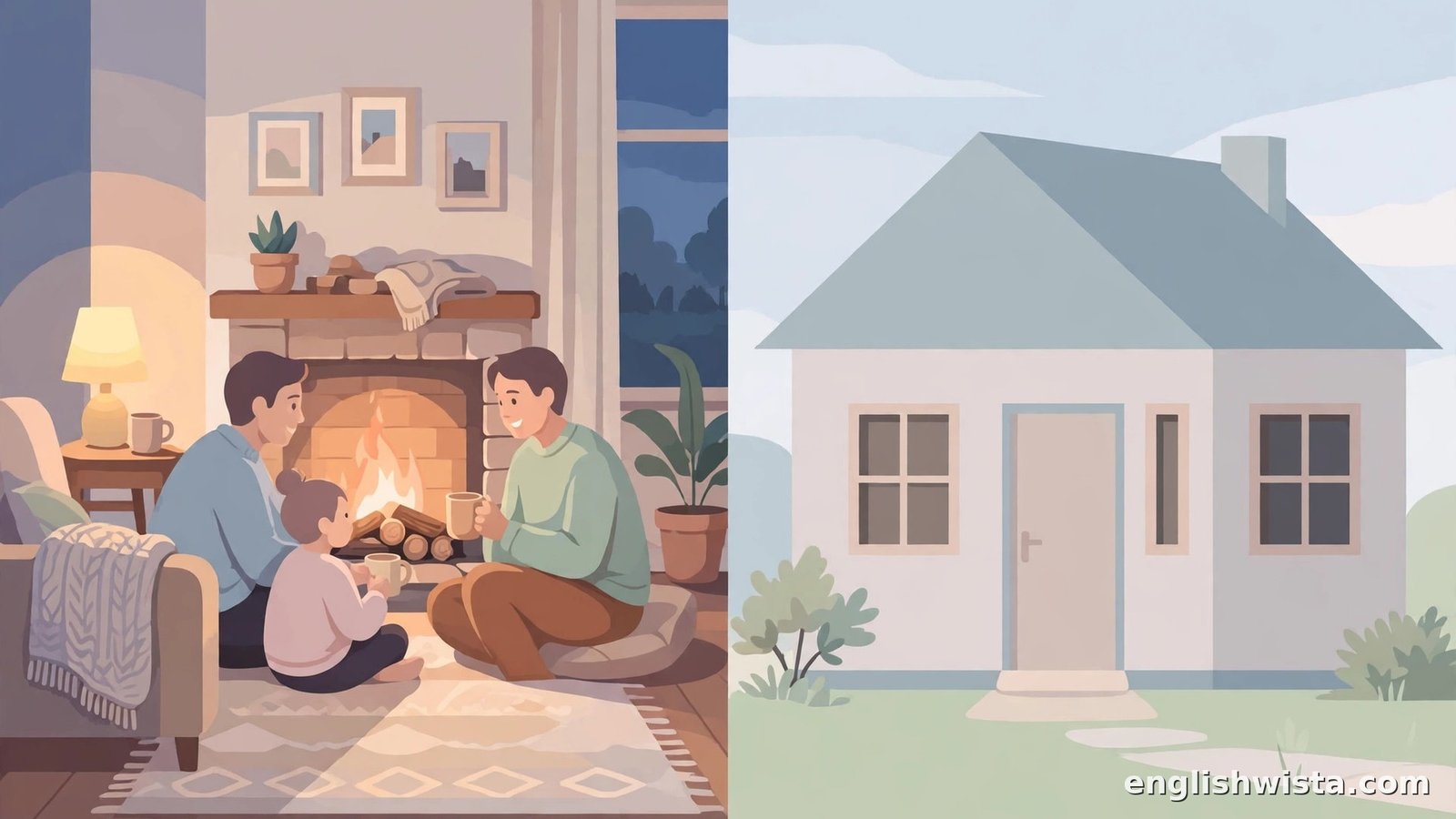
The simple difference is this: a house is a physical building where people live — walls, a roof, rooms, and doors. A home is the feeling of that place: comfort, safety, family, and belonging. So a builder builds a house, but the people who live in it make it a home.
House: The Building Word
House (pronounced “hows”) is a noun meaning a building made for people to live in. It is about the structure itself — its size, its rooms, its price, and its address.
- They bought a three-bedroom house near the park.
- The house has a red roof and a small garden.
- Our new house is still being built.
Home: The Feeling Word
Home (pronounced “hohm”) is a noun meaning the place where you live and feel you belong. It can be a house, a flat, a village, or even a country. It is also used in phrases like “home sweet home” and “feel at home”.
- There is no place like home.
- After a long trip, she was happy to be home.
- He made himself at home in his new city.
The Easy Trick to Remember
- House is made of bricks; home is made of feelings. You can count the rooms of a house, but you feel a home in your heart.
- Home has an “m” — like “my”. Home is personal — my home, my family, my place.
- You can own many houses, but you have one home — the place where you truly belong.
- Say it as a rhyme: “A house is built of wood and stone, but a home is where love has grown.”
Example Pairs
- They sold their old house last year. / She finally felt at home in the new city.
- The house on the hill is for sale. / After ten years abroad, he returned home.
- Our house has four bedrooms. / This town will always be my home.
Common Mistakes to Avoid
Wrong: I am going to my house for the holidays.
Right: I am going home for the holidays.
Wrong: The builder built a beautiful home of bricks.
Right: The builder built a beautiful house of bricks.
Wrong: Make yourself at house here.
Right: Make yourself at home here.
Frequently Asked Questions
Can “home” also mean a building? Yes, in everyday speech people often say “home” when they mean the building they live in. But careful English keeps the feeling separate from the structure.
What is a “house” in other uses? “House” can also mean a business, like a publishing house, or a family line, like the House of Windsor.
What does “homeless” mean? It means having no home — no place to live and belong. That is why it is “homeless”, not “houseless”.
Mini Quiz: Test Yourself
- 1. They bought a new ___ with a big garden.
- 2. After a long journey, I was glad to be ___.
- 3. The ___ on the corner has a blue door.
- 4. There is no place like ___.
- 5. Make yourself at ___ and have some tea.
Answers: 1. house, 2. home, 3. house, 4. home, 5. home.
Quick Recap
- House = the physical building — walls, roof, rooms (think: bricks and stone).
- Home = the place where you live and belong — comfort, family, and feeling (think: “my” home).
- A house becomes a home when people live in it with love and warmth.
- Fixed phrases like “feel at home” and “go home” always use “home”.
Conclusion
Now you know the simple difference: a house is a building, and a home is where your heart lives. Keep the memory trick in mind, practice with the example sentences, and you will never mix up these two everyday words again.