Do you ever write “weather” and wonder if it should be “whether”? You are not alone! These two sound exactly the same but mean completely different things. One is about rain and sunshine, the other is about choices. Today, we will clear it up once and for all with a simple rule and easy examples you can actually remember.
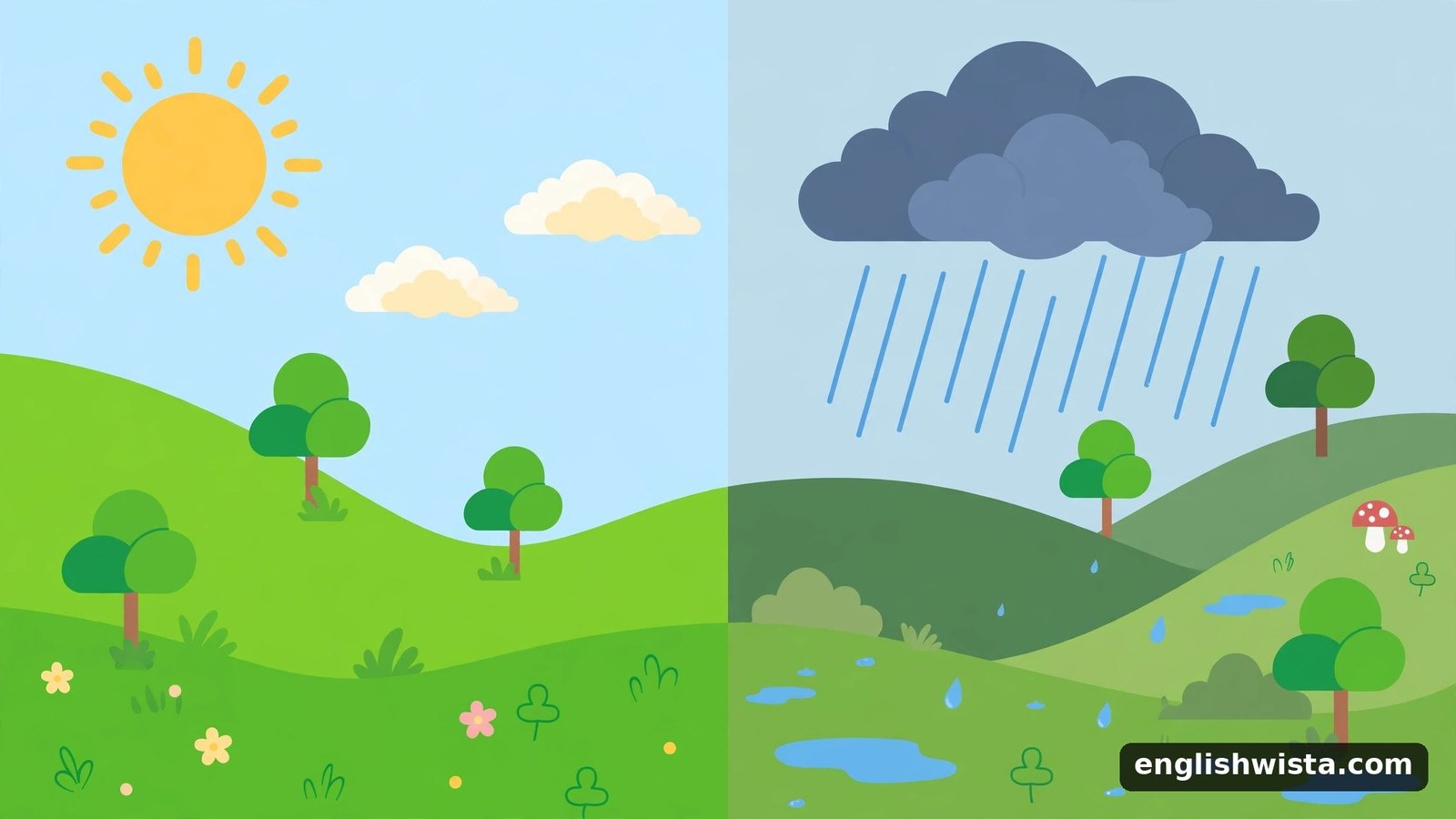
What Is the Simple Difference?
Here is the short answer you can use almost every time:
- Weather = the conditions outside — sun, rain, wind, temperature (a noun).
- Whether = “if” — used when talking about choices or possibilities (a conjunction).
Think of it this way: check the weather outside; ask whether (if) you’ll need an umbrella.
Weather: Outside Conditions
Use weather for the state of the atmosphere — hot, cold, rainy, sunny.
- The weather is beautiful today. (Outside conditions.)
- Bad weather delayed our flight. (Storms.)
- What’s the weather like in Karachi? (Conditions there.)
- We enjoyed sunny weather all week. (Sunshine.)
If it is about the sky and temperature, it is weather.
Whether: If / Choices
Use whether to introduce a choice or doubt — it works like “if.”
- I don’t know whether he’ll come. (If he will.)
- She asked whether I was ready. (If I was.)
- Whether you like it or not, we are leaving. (Choice between options.)
- Decide whether to stay or go. (Choose if.)
If you can replace it with “if,” it is whether.
The Easy Trick to Remember
Here is a trick that never fails:
- Weather → contains “we” + the sky — just ask: can I see it outside? Then it’s weather.
- Whether → contains “which”-energy: it asks which option — if this or that.
Even simpler test: replace the word with “if.” If the sentence still makes sense, use whether. If not, it’s weather.
Try it:
- “Tell me whether you’re coming.” — “if” works! Correct!
- “The weather is hot.” — “if” doesn’t work — it’s outside conditions! Correct!
If-test = whether. Sky = weather. That is the whole secret!
Weather vs Whether in Example Sentences
Let us look at real-life pairs side by side:
- The weather ruined the picnic. / I wonder whether the picnic is canceled.
- Check the weather first. / Check whether it will rain.
In each pair, weather = conditions and whether = if.
Common Mistakes to Avoid
Mistake 1: “Whether” for conditions.
- Wrong: “The whether is cold today.”
- Right: “The weather is cold today.” (Conditions!)
Mistake 2: “Weather” for choices.
- Wrong: “I don’t know weather she agrees.”
- Right: “I don’t know whether she agrees.” (If!)
Mistake 3: “Whether or not” overuse. Often “or not” is unnecessary: “Tell me whether you’re coming” is complete. But “whether or not” is correct when meaning “regardless”: “Whether or not it rains, we go.” Both forms exist — just don’t mix them up with weather!
Frequently Asked Questions
Are they pronounced the same? Yes — both sound like “WETH-er.” Only spelling and meaning differ.
What does “under the weather” mean? Feeling sick! “I’m a bit under the weather today.” A fixed idiom — always weather.
Can “weather” be a verb? Yes! “To weather a storm” = survive it; “the rock weathered” = worn by the elements. Still the sky-family word.
Is “whether” the same as “if”? Almost — but after prepositions and before “to” verbs, only whether works: “It depends on whether he calls” (not “if”).
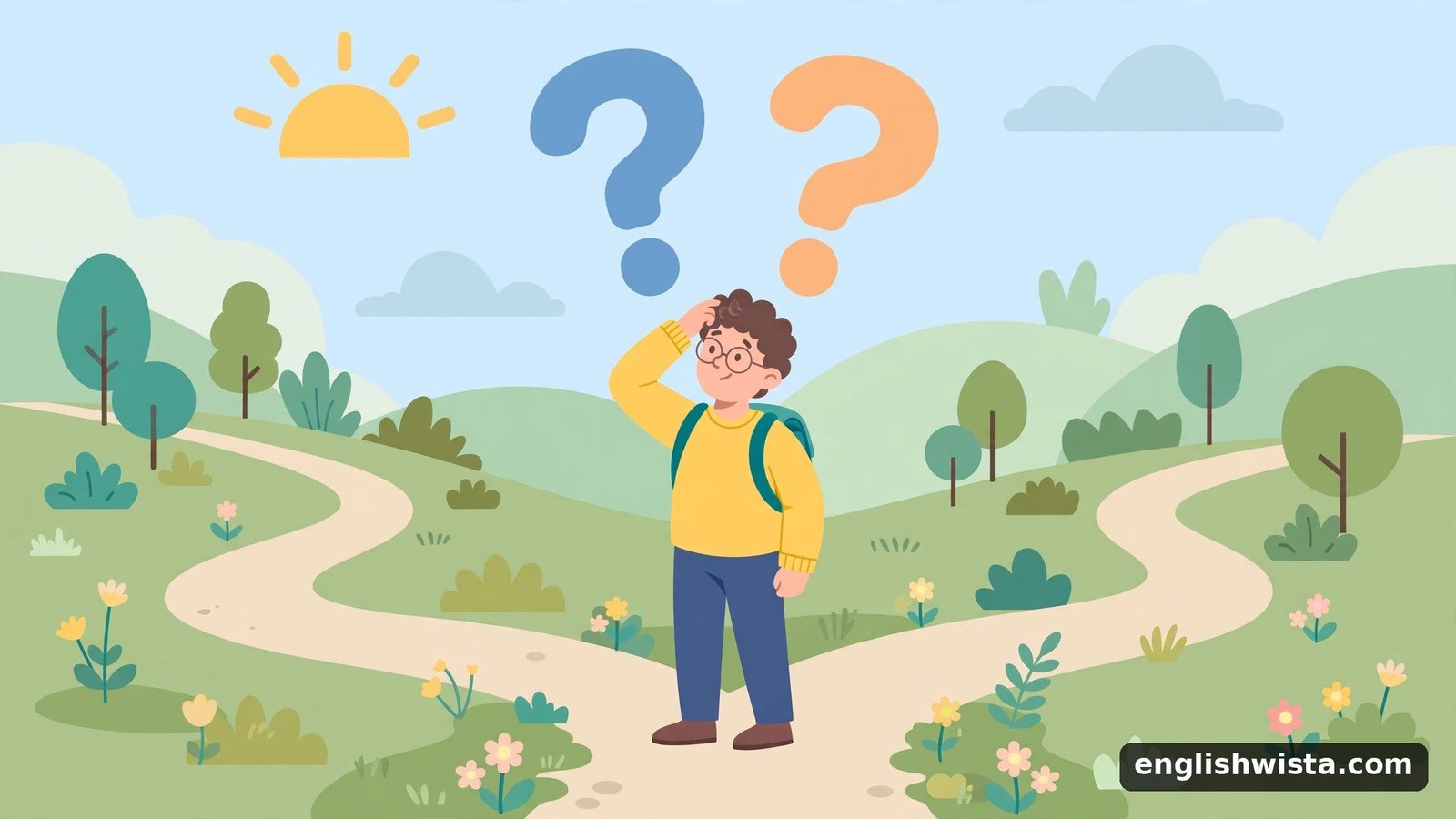
Mini Quiz: Test Yourself
Choose weather or whether for each sentence.
- 1. The _____ forecast says rain tomorrow.
- 2. Ask him _____ he wants tea or coffee.
- 3. Cold _____ makes me sleepy.
- 4. She hasn’t decided _____ to apply.
- 5. I’m feeling under the _____ today.
Answers: 1. weather (conditions) 2. whether (if/choice) 3. weather (conditions) 4. whether (if) 5. weather (idiom: sick)

Quick Recap
- Weather = outside conditions (sun, rain, wind).
- Whether = if; introduces choices.
- The “if” test: if “if” fits, it’s whether.
- “Under the weather” = feeling sick.
- Weather can be a verb (weather a storm); whether cannot.
Conclusion
So, weather or whether? Now you know: weather is what’s happening in the sky, and whether asks “if.” With the if-test in your pocket, you will never mix them up again. Keep practicing with real sentences, and soon the right word will come to you automatically!