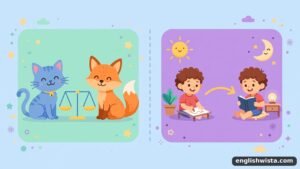
Do you ever write “discreet” and wonder if it should be “discrete”? You are not alone! These two sound exactly the same and differ by only one letter — but they mean completely different things. One is about being careful and quiet, the other is about things being separate. Today, we will clear it up once and for all with a simple rule and easy examples you can actually remember.

What Is the Simple Difference?
Here is the short answer you can use almost every time:
- Discreet (double e) = careful, quiet, not drawing attention.
- Discrete (ends in ete) = separate, distinct, individual.
Think of it this way: discreet people keep secrets; discrete things stay apart.
Discreet: Careful and Quiet
Use discreet (with double e) when someone is careful not to attract attention — tactful, subtle, private.
- She was discreet about the surprise party. (She kept it quiet.)
- He gave me a discreet nod across the room. (Subtle, unnoticed.)
- The hotel offers discreet service for VIP guests. (Private, low-profile.)
- Please be discreet — don’t tell anyone yet. (Keep it secret.)
If it is about keeping things quiet, it is discreet.
Discrete: Separate and Distinct
Use discrete (ending in ete) when things are separate and individual — not joined together.
- The course is divided into three discrete modules. (Three separate parts.)
- Scientists studied several discrete populations. (Distinct groups.)
- These are two discrete problems, not one. (Separate issues.)
If it is about things being apart from each other, it is discrete.
The Easy Trick to Remember
Here is a trick that never fails. Look at the middle letters:
- Discreet → the double ee hides together quietly, like a secret.
- Discrete → the ts are separated, standing apart.
Try it:
- “Be discreet about the news.” — keep it quiet! Correct!
- “Two discrete categories.” — two separate ones! Correct!
Quiet secret = discreet. Separate things = discrete. That is the whole secret!
Discreet vs Discrete in Example Sentences
Let us look at real-life pairs side by side:
- He was discreet about his wealth. / His wealth came from three discrete sources.
- A discreet investigation began. / The report covered five discrete topics.
In each pair, discreet = quiet and discrete = separate.
Common Mistakes to Avoid
Mistake 1: “Discrete” for keeping secrets.
- Wrong: “Please be discrete about this.”
- Right: “Please be discreet about this.” (Keep it quiet!)
Mistake 2: “Discreet” for separate parts.
- Wrong: “The machine has four discreet parts.”
- Right: “The machine has four discrete parts.” (Separate parts!)
Mistake 3: Mixing up the adverbs. Discreetly = quietly (“she discreetly left”). Discretely = separately (“the two issues were handled discretely”). Rare, but the same rule applies.
Frequently Asked Questions
Are they pronounced the same? Yes — both sound like “dis-KREET.” The difference is only in spelling and meaning, which is why the letter trick matters.
Which one is more common? Discreet (careful/quiet) is far more common in everyday English. Discrete shows up mostly in academic, technical, or scientific writing.
What is the noun form of “discreet”? Discretion — “Use your discretion” means use careful judgment. (Don’t confuse it with “discrete”!)
Can a person be “discrete”? Only in the sense of being separate — which sounds odd. People are discreet; things are discrete.

Mini Quiz: Test Yourself
Choose discreet or discrete for each sentence.
- 1. Please be _____ — this is confidential.
- 2. The system has three _____ components.
- 3. She gave him a _____ warning.
- 4. These are _____ events, not connected.
- 5. A _____ inquiry will be conducted.
Answers: 1. discreet (keep quiet) 2. discrete (separate parts) 3. discreet (subtle) 4. discrete (separate) 5. discreet (quiet)
Quick Recap
- Discreet (ee) = careful, quiet, secretive.
- Discrete (ete) = separate, distinct.
- The trick: double-ee hides quietly; the t’s stand apart.
- People are discreet; things are discrete.
- Noun: discretion (careful judgment).
Conclusion
So, discreet or discrete? Now you know: discreet keeps secrets quietly, and discrete keeps things separate. With the letter trick in your pocket, you will never mix them up again. Keep practicing with real sentences, and soon the right word will come to you automatically!