Have you ever come across a sentence that sounded a little strange but carried a deeper meaning? Something like “It’s raining cats and dogs” or “A stitch in time saves nine”? If yes, you’ve already met idioms and proverbs.
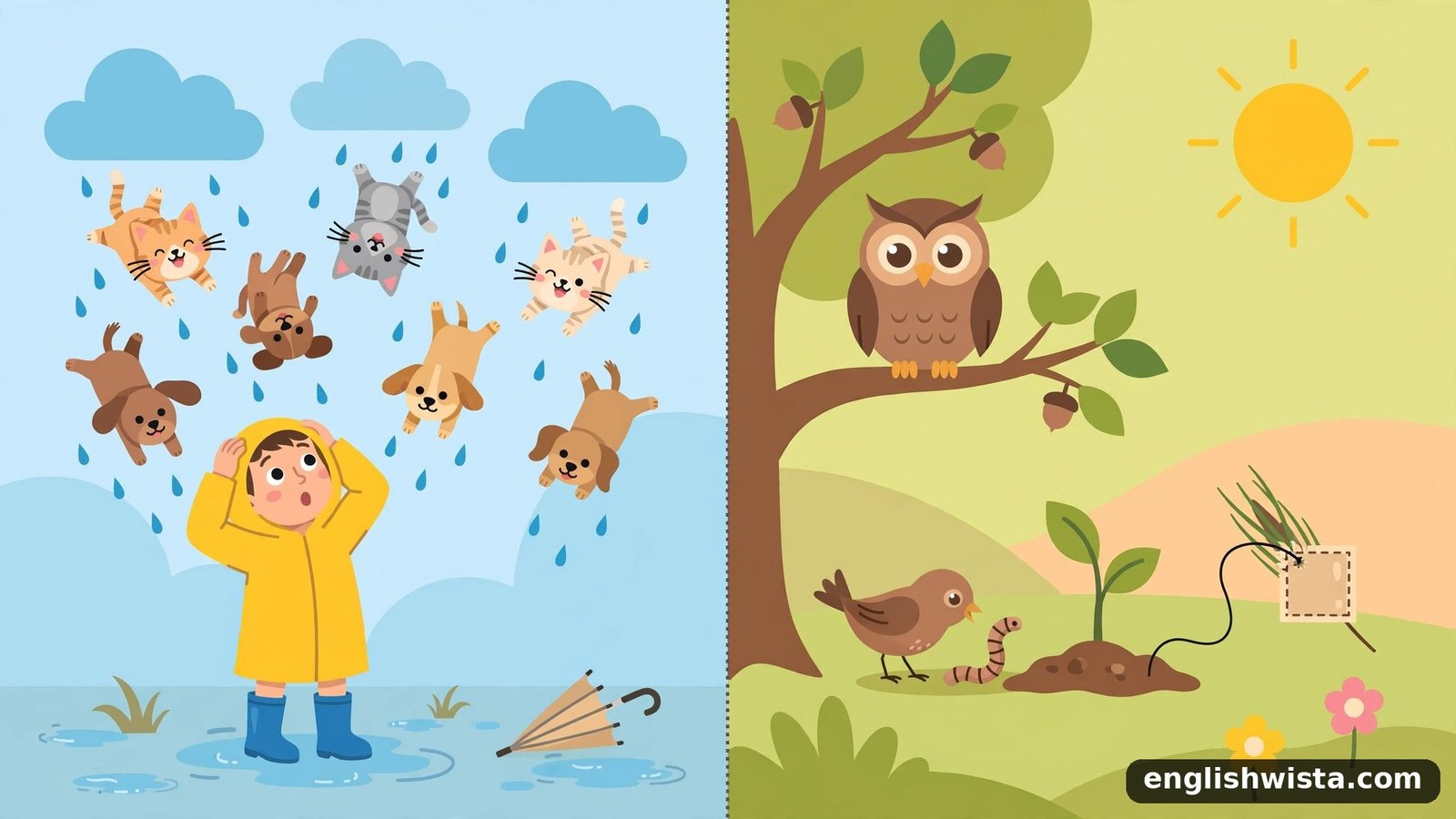
These two types of expressions are common in English and many other languages. But here’s the catch—people often confuse them. Some think they mean the same thing. Others mix up these commonly confused words and don’t know how to tell them apart. Don’t worry! By the end of this article, you’ll clearly understand the difference between idioms and proverbs, how to use them, and even how to spot them in everyday conversations.
Let’s take a closer look in a step-by-step way.
What Is an Idiom?
An idiom is a fixed phrase — a group of words whose meaning is not directly clear from the individual words. In other words, the expression has a “hidden” or “figurative” meaning.
For example:
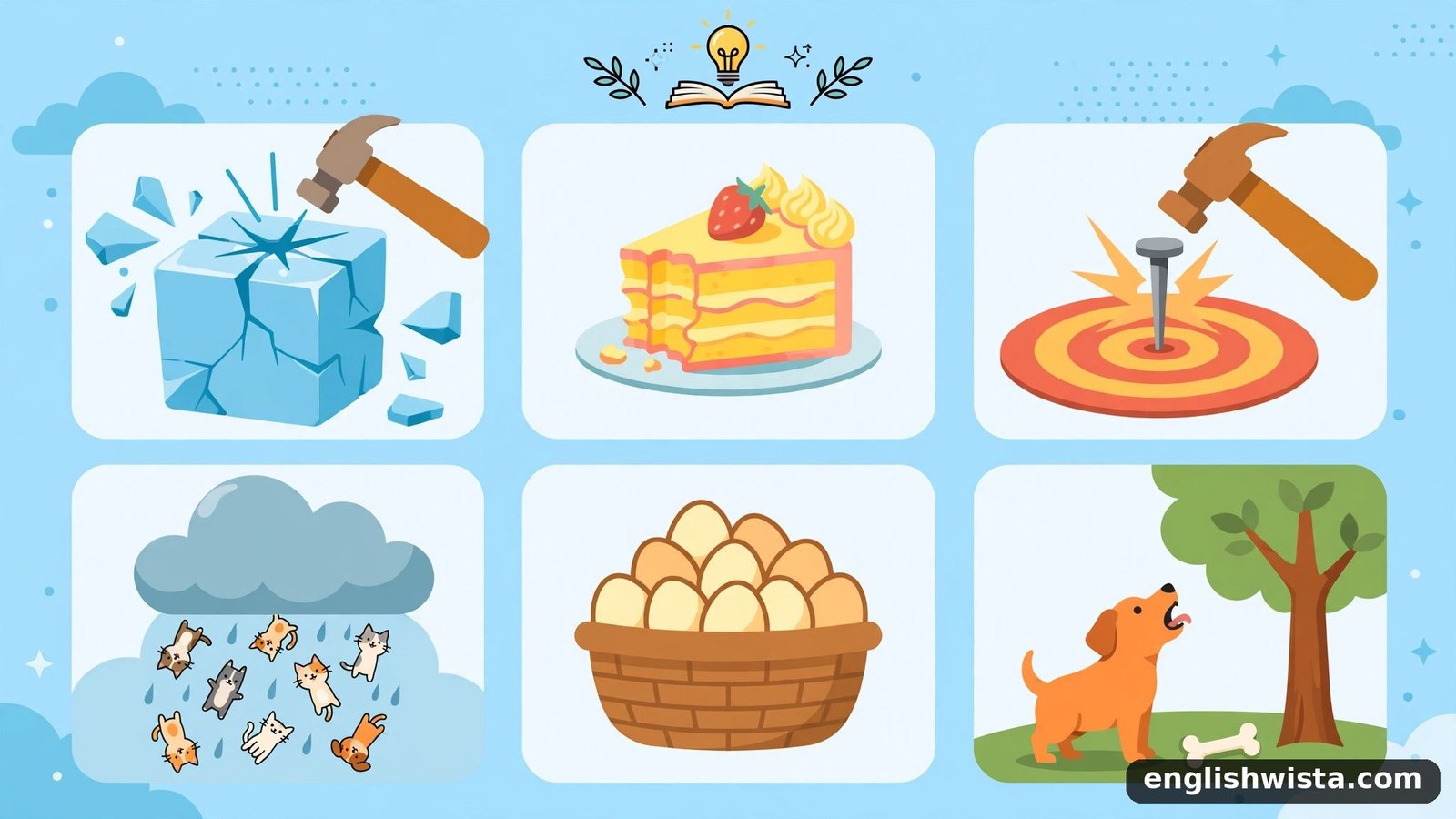
- “Break the ice” → to start a conversation in a friendly way.
- “Spill the beans” → to reveal a secret.
- “Hit the sack” → to go to sleep.
If you look at the words literally, they don’t make much sense. But when you know the idiom, the meaning becomes clear.
Definition in simple words:
An idiom is a phrase that says something in a colorful or indirect way, instead of saying it plainly.
What Is a Proverb?
A proverb is a short, well-known saying that gives advice, shares wisdom, or teaches a lesson.
For example:
- “Actions speak louder than words.” → What you do is more important than what you say.
- “Don’t count your chickens before they hatch.” → Don’t assume something will happen before it actually does.
- “The early bird catches the worm.” → Being early or prepared gives you an advantage.
Proverbs are like little life lessons packed into one sentence. They’re often passed down from generation to generation.
Definition in simple words:
A proverb is a short saying that teaches a truth, moral, or piece of advice.
Key Difference Between Idioms and Proverbs
Now that we’ve seen what idioms and proverbs are, let’s compare them side by side.
- Meaning:
- Idioms have a hidden meaning that is different from the literal words.
- Proverbs have a clear message or lesson.
- Purpose:
- Idioms are used to make language colorful, creative, and fun.
- Proverbs are used to teach or remind people of wisdom and advice.
- Examples:
- Idiom: “Kick the bucket” → to die.
- Proverb: “Honesty is the best policy.” → Always be honest.
Think of it this way:
- Idioms decorate language.
- Proverbs guide life.
Why Do People Confuse Idioms and Proverbs?
One of the most common pitfalls for learners is mixing them up, because both idioms and proverbs are common phrases that don’t always use plain language. Also, both are often used in conversations, stories, or literature.
But here’s a simple memory trick to remember:
- If it teaches you something, it’s a proverb.
- If it sounds unusual but means something else, it’s an idiom.
Real-Life Examples of Idioms
Here are some idioms in action:
- “I was nervous at the party, but Jane broke the ice by telling a funny story.”
- “Don’t spill the beans about the surprise birthday.”
- “After a long day at work, I’m ready to hit the sack.”
Notice how none of these sentences make sense if you take the words literally. Nobody is breaking real ice or spilling actual beans here!
Real-Life Examples of Proverbs
Here are some proverbs in real conversations:
- “Don’t put all your eggs in one basket.” → Use different options to reduce risk.
- “A picture is worth a thousand words.” → Images can communicate better than long explanations.
- “Rome wasn’t built in a day.” → Big achievements take time and effort.
Each of these proverbs gives advice or a reminder about life.
Idioms vs. Proverbs: Quick Comparison Table
| Feature | Idioms | Proverbs |
|---|---|---|
| Meaning | Figurative, hidden meaning | Clear, moral lesson or advice |
| Purpose | Make speech fun and colorful | Teach wisdom or life lessons |
| Example | “Let the cat out of the bag” | “Time and tide wait for no man” |
| Understanding | Must be learned as phrases | Easy to understand once explained |
Are Idioms and Proverbs Universal?
Yes, almost every language has idioms and proverbs. They may not be the same words, but the idea exists everywhere — and their word origin stories often say a lot about the culture they come from.
For example:
- In English: “Don’t cry over spilled milk.”
- In Spanish: “No llores sobre la leche derramada.” (Literally the same idea.)
Proverbs especially are common across cultures because people everywhere like to pass down wisdom. Idioms, on the other hand, are often unique to a culture or region.
Common Mistakes with Idioms and Proverbs
Here are some common mistakes learners often struggle with:
- Translating word-for-word – Idioms don’t always make sense when directly translated.
- Example: Saying “Kick the bucket” in another language might confuse people.
- Mixing idioms and proverbs – Remember: idioms decorate, proverbs teach.
- Using idioms too formally – Idioms are best in casual conversation, not in serious reports or academic writing.
Fun Facts About Idioms and Proverbs
- Some idioms come from history. For example, “Bite the bullet” came from old times when soldiers literally bit on a bullet during painful medical procedures without anesthesia.
- Proverbs are often very old. Some proverbs in English can be traced back hundreds of years, and some even appear in ancient texts like the Bible.
- Idioms make language more fun. Imagine saying “I’m very tired.” Now compare it with “I’m dead on my feet.” The second one feels more expressive, right?
How to Learn Idioms and Proverbs Easily
Here are some practice tips if you’re learning English (or any other language):
- Learn in context – Don’t just memorize. Read stories, watch movies, or listen to conversations.
- Practice with examples – Try making your own sentences with idioms and proverbs.
- Focus on common ones first – Start with the ones you hear most often, like “Better late than never” (proverb) or “Piece of cake” (idiom).
- Don’t overuse them – A few idioms make your speech colorful, but too many can confuse listeners.
Step-by-Step Way to Tell Them Apart
- Read or hear the phrase.
- Ask: “Does it teach a lesson?”
- If yes → it’s a proverb.
- Ask: “Does it mean something different from the words?”
- If yes → it’s an idiom.
Simple as that!
Quick Practice Exercise
Let’s test your understanding with a quick quiz. Decide if each of these is an idiom or a proverb:
- “The grass is always greener on the other side.”
- “Burning the midnight oil.”
- “Practice makes perfect.”
- “Under the weather.”
- “You can’t have your cake and eat it too.”
Answers:
- Proverb
- Idiom
- Proverb
- Idiom
- Proverb
Conclusion
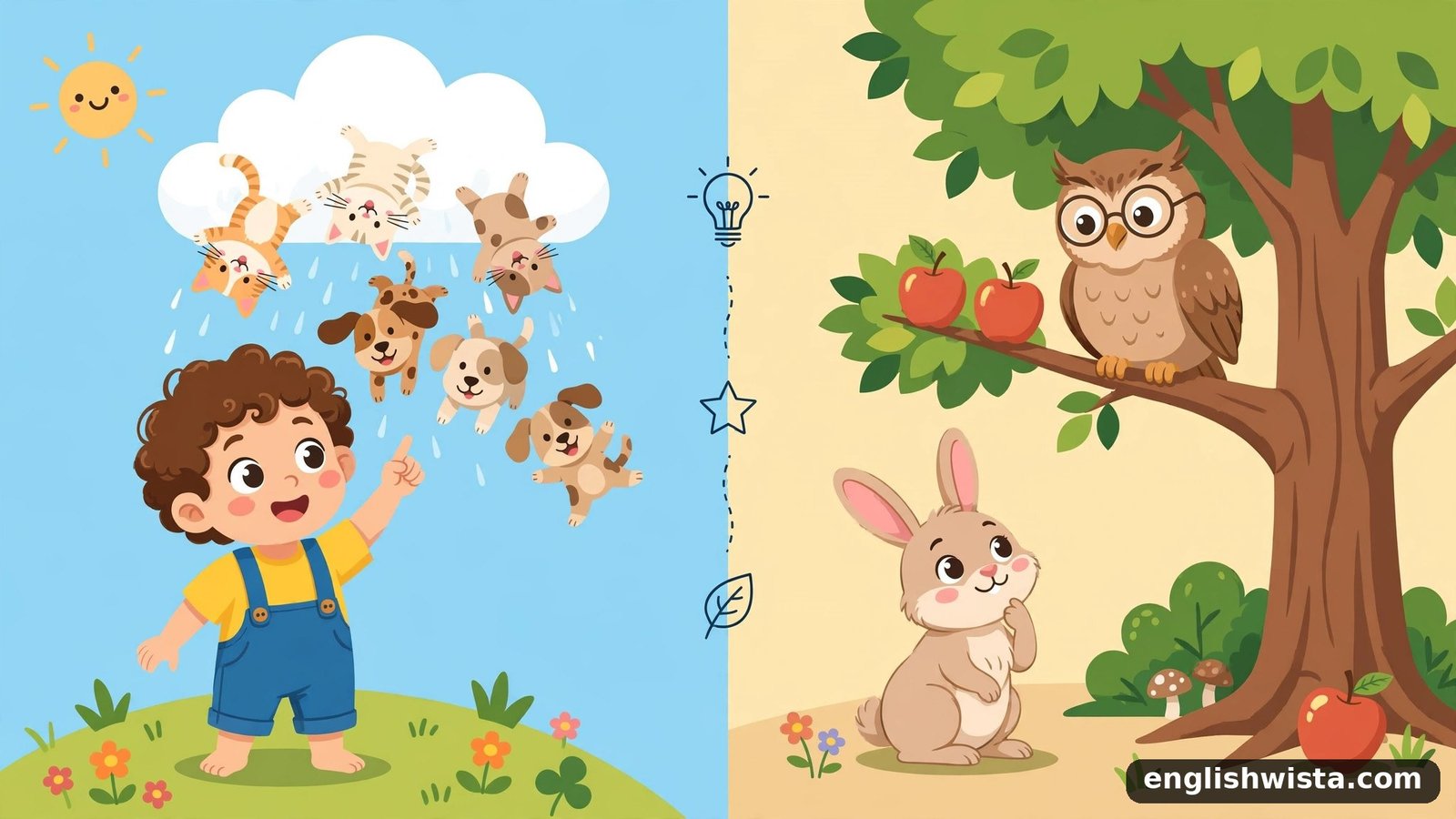
Idioms and proverbs may look similar, but now you know how different they really are. Idioms are playful expressions with hidden meanings, while proverbs are wise sayings that give advice. One adds color to your language, and the other adds wisdom to your life.
The next time you hear someone say “Don’t bite off more than you can chew” or “It’s a blessing in disguise,” you’ll be able to smile and think, “Ah, I know exactly what that is!”
So remember:
- Idioms = colorful language.
- Proverbs = life lessons.
And that’s the difference explained in the simplest way possible.
Mnemonic: A Memory Trick to Never Forget It
Here is a simple memory trick that never fails: “Idioms paint, proverbs preach.” Idioms paint a colorful picture with a hidden meaning — nobody really spills beans or breaks ice. Proverbs preach: they hand you advice or a life lesson, like “honesty is the best policy.”
Use this quick test before you label any expression — ask yourself: “Is it giving me advice?” If yes, it is a proverb. If it is just a colorful, non-literal way of saying something, it is an idiom.
Prefer a visual trick? Match the first letters: Idiom = Indirect meaning, Proverb = Practical wisdom. Repeat it a few times, and the difference will stick for good.
Frequently Asked Questions
What is the difference between idioms and proverbs?
An idiom is a fixed phrase with a figurative, “hidden” meaning you cannot guess from the individual words (for example, “break the ice”). A proverb is a short, well-known saying that gives advice or shares wisdom (for example, “practice makes perfect”). In short: idioms add color, proverbs add wisdom.
Can an expression be both an idiom and a proverb?
Rarely. Most expressions are clearly one or the other. Use the quick test: if the saying gives advice or a life lesson, treat it as a proverb; if it simply describes something in a colorful, non-literal way, it is an idiom.
How can I remember the difference between idioms and proverbs?
Try the mnemonic “Idioms paint, proverbs preach.” Idioms paint a picture with hidden meaning, while proverbs preach a lesson. You can also use the alphabet trick: Idiom = Indirect, Proverb = Practical advice.
Do idioms and proverbs work the same in every language?
Not exactly. Proverbs travel well across cultures because their wisdom is universal, but idioms are often unique to one language or region — that is why translating an idiom word for word usually sounds strange. Learning a language’s idioms is one of the best ways to sound natural.