Do you ever write “reach” and wonder if it should be “arrive”? You are not alone! Both get you somewhere — but one names the destination and the other names the journey’s end. Today, we will clear it up once and for all with a simple destination rule.

What Is the Simple Difference?
Here is the short answer you can use almost every time:
- Arrive = to get to a place — usually with “at” or “in.” (“Arrive at the station.”)
- Reach = to arrive at / touch / achieve something — no preposition needed, takes an object. (“Reach the station.”)
Think of it this way: arrive lands you; reach grabs the target.
Arrive: Getting There
Use arrive for the moment of getting to a destination — it pairs with “at” (specific places) and “in” (cities/countries).
- We arrived at the hotel. (Specific place = at.)
- She arrived in Paris. (City/country = in.)
- The train arrived on time. (No place named — just the event.)
- He arrived late. (The timing of getting there.)
If the sentence is about getting somewhere, it is arrive.
Reach: Touching the Target
Use reach when you get to, touch, contact, or achieve something — it takes the target directly as its object.
- We reached the hotel. (Hotel = object, no “at”!)
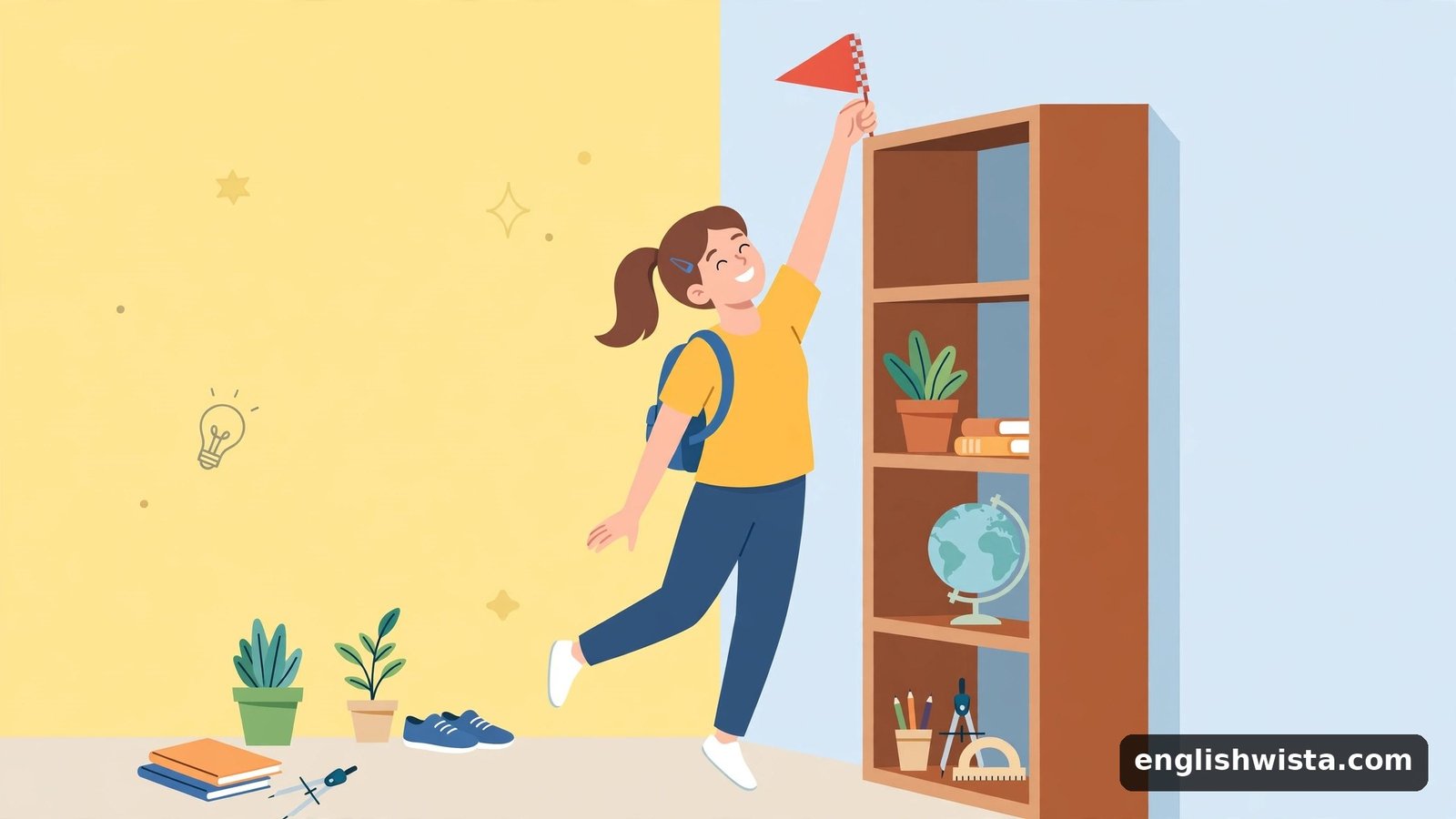
- Can you reach the top shelf? (Touch it.)
- Call me when you reach home. (Get to home.)
- She reached her goal. (Achieved it — figurative!)
If the target is the direct object, it is reach.
The Easy Trick to Remember
Here is a trick that never fails — the preposition test:
- Is there an “at” or “in” before the place? → arrive (“arrive at/in”).
- Does the place follow directly, with no preposition? → reach (“reach the station”).
Try it:
- “We arrived at school.” — “at” present! Correct!
- “We reached school.” — no preposition! Correct!
At/in = arrive. Direct object = reach. That is the whole secret!
Arrive vs Reach in Example Sentences
Let us look at real-life pairs side by side:
- They arrived in London. / They reached London by nightfall.
- When did you arrive? / Did you reach him by phone? (Contact sense!)
In each pair, arrive reports the landing and reach reports the contact.
Common Mistakes to Avoid
Mistake 1: “Reach at.”
- Wrong: “We reached at the station.”
- Right: “We reached the station.” / “We arrived at the station.”
Mistake 2: “Arrive” with a direct object.
- Wrong: “We arrived the station.”
- Right: “We arrived at the station.” (Arrive needs its preposition!)
Mistake 3: “Reach” for people you can’t contact. “Reach” also means contact: “I couldn’t reach her” (couldn’t get through). “Arrive” can never mean contact — that is reach-only territory.
Frequently Asked Questions
What about “arrive home”? “Home” is special — no preposition: “We arrived home.” (Like “go home.”) But “reached home” also works. Home breaks the at/in rule!
What is “reach out”? A phrasal verb meaning to contact someone for help or connection: “Reach out if you need anything.” Business and friendly — slightly overused, but standard.
Can “reach” mean a level? Yes: “Temperatures will reach 40 degrees” (attain a level). Arrive can’t do levels — reach owns achievement and extent.
How are they pronounced? Arrive = “uh-RYV”; reach = “reech” (long e).
Mini Quiz: Test Yourself
Choose arrive or reach for each sentence.
- 1. We _____ at the airport early.
- 2. Can you _____ the book on the top shelf?
- 3. She _____ in Tokyo yesterday.
- 4. I couldn’t _____ him all day.
- 5. The team _____ the finals.
Answers: 1. arrived (at = arrive) 2. reach (touch it) 3. arrived (in = arrive) 4. reach (contact) 5. reached (achieved)

Quick Recap
- Arrive = get to a place, with at (places) / in (cities, countries).
- Reach = get to / touch / contact / achieve, direct object, no preposition.
- Preposition test: at/in = arrive; direct = reach.
- “Arrive home” is the exception (no preposition).
- Reach owns contact (“couldn’t reach her”) and levels.
Conclusion
So, arrive or reach? Now you know: arrive lands you at a place, and reach puts the target in your hands. With the preposition test in your pocket, you will never mix them up again. Keep practicing with real sentences, and soon the right word will come to you automatically!