Maybe and may be sound exactly the same, but they are different parts of speech. One is an adverb that means perhaps, and the other is a verb phrase that talks about a possibility. Many learners mix them up because they are pronounced the same way. This simple guide will help you understand the difference with easy examples, a memory trick, and a mini quiz.
What Is the Simple Difference?
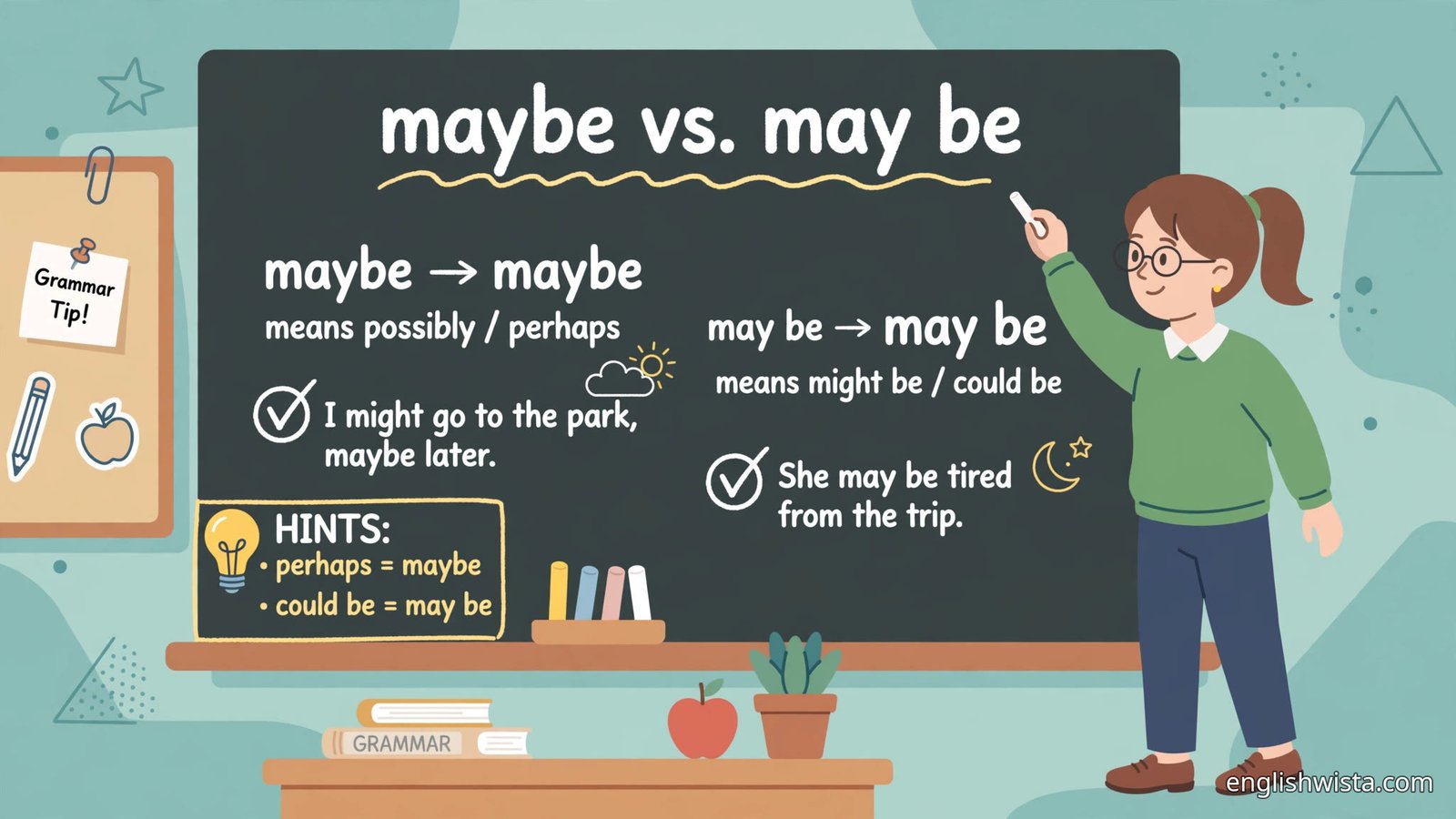
The simple difference is this: maybe (one word) is an adverb that means perhaps or possibly, while may be (two words) is a verb phrase made of the modal may plus the verb be. So when you are not sure about the answer, you say maybe. When you talk about what might exist or happen, you say it may be true. Remember: maybe answers “perhaps”, may be answers “could it be”.
Maybe: The Perhaps Adverb
Maybe is an adverb that means perhaps or possibly. It usually comes at the start of a sentence or before a verb, and it shows that you are not sure about something.
- Maybe it will rain tomorrow.
- Maybe she forgot about the meeting.
- I will maybe come to your party.
May Be: The Possibility Verb Phrase
May be is a verb phrase made of the modal verb may and the verb be. It talks about a possibility — something that could be true or could happen. Notice that you can change may to might and the meaning stays the same.
- It may be cold tonight.
- She may be the best player on the team.
- The keys may be on the kitchen table.
The Easy Trick to Remember
- The might test. Replace “may” with “might”. If the sentence still works, you need two words: “It may be cold” → “It might be cold” works, so may be is right.
- The perhaps test. Replace it with “perhaps”. If the sentence still works, you need one word: “Maybe it will rain” → “Perhaps it will rain” works, so maybe is right.
- May be can be split: “may not be”, “may never be”. You can never split maybe.
- Say it as a rhyme: “Maybe it may be true, that is up to you.”
Example Pairs
- Maybe we should leave early. / The road may be busy this morning.
- Maybe he is sleeping. / He may be sleeping right now.
- Maybe the shop is still open. / The shop may be closed already.
Common Mistakes to Avoid
Wrong: May be I will visit you on Sunday.
Right: Maybe I will visit you on Sunday.
Wrong: The answer maybe wrong.
Right: The answer may be wrong.
Wrong: Maybe be careful on the stairs.
Right: May be is not needed here — just say: Be careful on the stairs.
Frequently Asked Questions
Is “may be” the same as “might be”? Almost. Both talk about possibility. “May be” sounds a little more formal and a little more hopeful; “might be” sounds a little less certain.
Can “maybe” go in the middle of a sentence? Yes: “I will maybe call you later.” But it is most common at the start: “Maybe I will call you later.”
Is “may be” always two separate words? Yes. “May” is the modal verb and “be” is the main verb, so they are always written separately: “may be”, “may not be”.

Mini Quiz: Test Yourself
- 1. ___ we will go to the beach this weekend.
- 2. The test ___ be difficult this year.
- 3. ___ she will answer the phone.
- 4. This ___ be the tallest building in the city.
- 5. ___ he forgot his keys at home.
Answers: 1. Maybe, 2. may, 3. Maybe, 4. may, 5. Maybe.
Quick Recap
- Maybe = perhaps (one word, an adverb).
- May be = could be (two words, a modal verb phrase).
- “Perhaps” fits maybe; “might be” fits may be.
- May be can take “not” between the words: “may not be”.
Conclusion
Now you know the simple difference: maybe means perhaps and may be means could be. Keep the swap test in mind, practice with the example sentences, and you will never mix up these two look-alike words again.