
Have you ever typed a word, paused, and thought, “Wait… is that spelled right?” You’re not alone. One of the most commonly confused words you’ll meet is Excel—sometimes mistakenly written as Excell. At first glance, the two look almost the same. Just one extra “l” separates them. But here’s the twist: only one is correct, and the other is a common misspelling.

In this article, we’re going to take a deep dive into this word pairs comparison: Excell vs Excel. We’ll explore what the correct word means, where it comes from, how to use it in real-life sentences, and why so many people add that sneaky extra “l.” By the end, you’ll feel confident every time you see or write this word.
So, let’s take a closer look.
The Core Question: Excell or Excel?
The short answer: Excel is the correct spelling.
The word Excell does not exist in standard English dictionaries. If you write “Excell” with two L’s, most people (and spell-check tools) will mark it as wrong.
Excel is the right word. It’s a verb that means:
- to be very good at something
- to do something better than others
- to achieve an unusually high level of skill or success
Think of it this way: when you “excel” at something, you’re not just good at it—you stand out.
For example:
- “She excels in mathematics.”
- “He wants to excel in his career.”
Notice how the word always gives a positive, achievement-focused meaning.
Why Do People Write “Excell”?
If “Excel” is the correct word, why do we often see “Excell”? Here are a few reasons:
- Spelling habits: Many English words double the final “l” (like excellent, compelled, install). Because of this, people naturally assume “Excel” should follow the same pattern.
- Sound confusion: The pronunciation of “Excel” feels sharp and strong (ex-CEL), so adding another “l” looks like it should fit.
- Typing mistakes: Sometimes, it’s just a slip of the fingers. Adding an extra letter by accident happens all the time.
So, while “Excell” might look believable, it’s still a mistake.
Definition of “Excel”
Let’s keep things simple:
Excel (verb) = to do extremely well, to be better than others, to shine in a particular area.
That’s it. No complicated grammar explanation needed.
Example:
- “She wants to excel in sports.” (She wants to be very good at sports.)
- “He excels at cooking.” (He is better than most people at cooking.)
Real-Life Examples of “Excel”
To really understand a word, clear example sentences help a lot. Here are a few everyday ones with “Excel”:
- “Students who work hard often excel in their studies.”
- “She excels at painting landscapes.”
- “He is determined to excel in his new job.”
- “Athletes who train daily excel during competitions.”
- “The company excels in customer service.”
Notice how the word always brings out the idea of being above average or outstanding.
“Excel” vs. “Excellence”
You might have noticed another word: Excellence. It looks very similar to “Excel,” and that’s why people get mixed up.
- Excel is a verb (an action). Example: “She wants to excel in science.”
- Excellence is a noun (a thing/quality). Example: “Her excellence in science is admired.”
Both come from the same root, but they belong to different parts of speech, so they work differently in a sentence.
Think of it like this:
- To excel = to perform really well.
- Excellence = the quality of being really good at something.
The Origin of the Word “Excel”
Here’s a little word history — a quick look at this word’s Latin roots — for you.
The word excel comes from the Latin word excellere.
- Ex means “out” or “beyond.”
- Cellere means “rise” or “soar.”
Put together, it means “to rise above” or “to go beyond.” That’s exactly what the word still means today—to rise above others by doing something better.
Isn’t it cool that a word from centuries ago still carries the same idea today?
“Excel” in Everyday Life
You’ll see “excel” used in many situations, from formal writing to everyday conversation. Let’s explore a few:

1. In Education
- “She excels in English grammar.”
- “The school encourages students to excel in both academics and sports.”
2. In Careers
- “He wants to excel as a lawyer.”
- “Employees who excel are often promoted.”
3. In Hobbies and Skills
- “He excels at playing the guitar.”
- “They excel in baking delicious cakes.”
4. In Sports
- “Athletes who train daily excel in competitions.”
- “The team excels at teamwork and strategy.”
Whenever you hear “excel,” it almost always connects to success, effort, and improvement.
Microsoft Excel: Adding to the Confusion
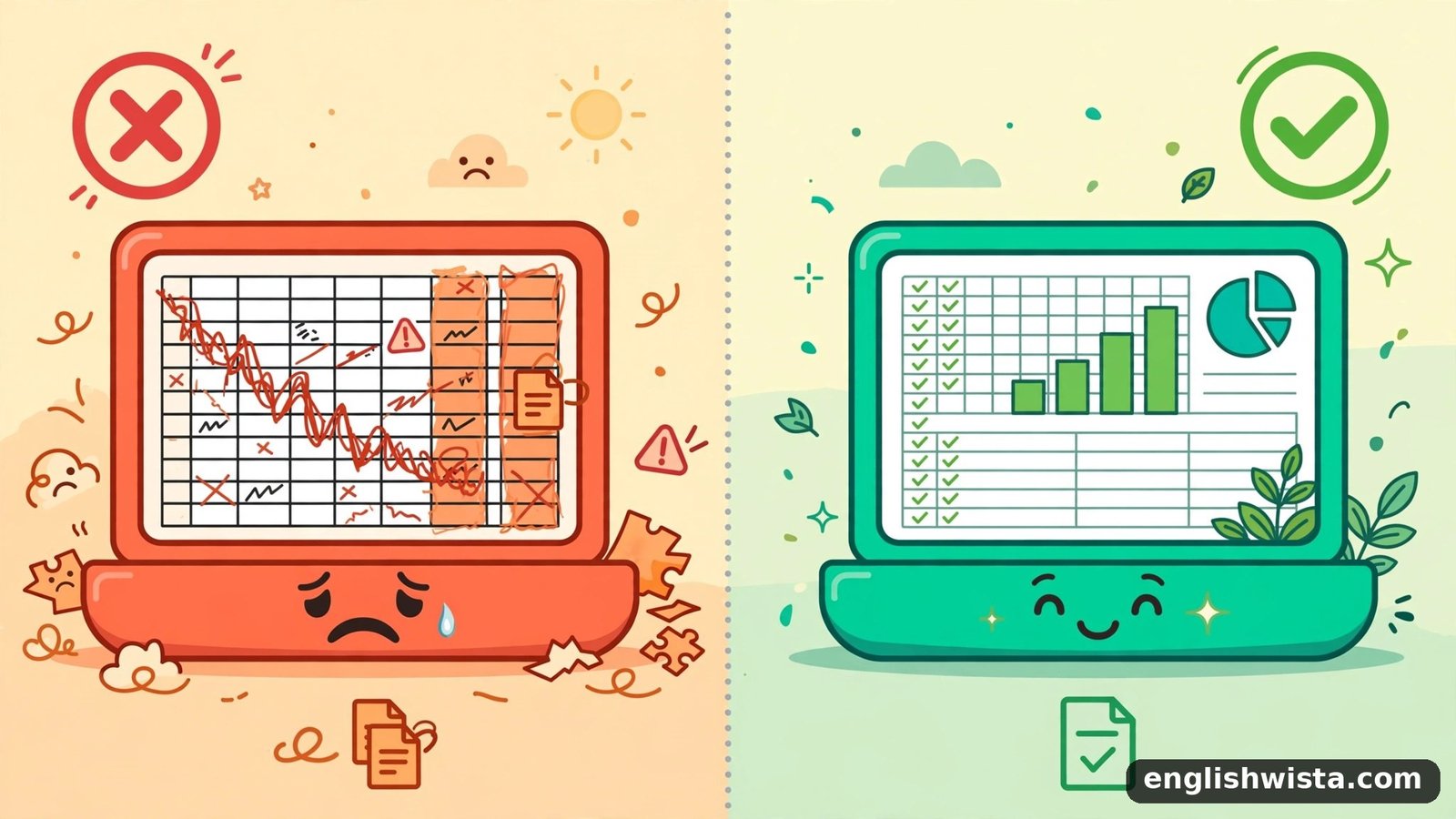
Here’s another reason people stumble over this pair of commonly confused words: they confuse the word with Microsoft Excel—the popular spreadsheet program.
But even in this case, the software is spelled Excel, not Excell. Microsoft chose that name because the program helps users “excel” in organizing data and calculations.
So, whether you’re talking about the verb or the software, it’s always spelled Excel.
Common Mistakes and How to Avoid Them
Here are a few common mistakes people make with this word, and how you can avoid them:
- Mistake: Writing “Excell”
- Fix: Remember, only one “l.”
- Mistake: Mixing up “Excel” and “Excellence”
- Fix: Use “excel” when it’s an action, and “excellence” when it’s a quality.
- Mistake: Forgetting its positive meaning
- Fix: Keep in mind, “excel” always means doing really well—not just doing okay.
A simple memory trick: Think of the program Microsoft Excel. It’s spelled with one “l.” If you can remember that, you’ll never forget the correct spelling.
Fun Facts About “Excel”
Here are some light, fun details to make this topic more memorable:
- The word “excel” has been in English since the 14th century.
- The past tense of excel is excelled (with two “l’s”). For example: “She excelled in her test.”
- The -ing form is excelling. For example: “He is excelling at his new job.”
- “Excell” is actually a common surname in some parts of the world. For example, Edwin Othello Excell was a well-known American hymn writer in the 19th century. But as a verb, it’s still wrong.
- Microsoft Excel was released in 1985, and since then, many people remember the word only because of the software.
Quick Comparison Table
Here’s a quick reference table to lock the concept in your mind:
| Word | Correct? | Meaning | Example Sentence |
|---|---|---|---|
| Excel | ✅ Yes | To do very well, to succeed | “She excels in science.” |
| Excell | ❌ No | Not a word (except as a last name) | Incorrect spelling |
Recap and Easy Takeaways
Before we wrap up, here’s a summary recap of the key points:
- Excel (one “l”) is the correct word.
- Excell (two “l’s”) is a common mistake.
- To excel means to be outstanding, to do something really well.
- It comes from Latin, meaning “to rise above.”
- Microsoft Excel uses the same word, but it still has just one “l.”
- Related word: Excellence (the quality of excelling).
Conclusion
So, next time you’re unsure whether it’s “Excell” or “Excel,” remember this: the right word has just one L. The extra “l” might look tempting, but it doesn’t belong there.
The word excel is all about standing out, being better, and rising above — a positive meaning you can count on every time you see it in a sentence. Whether you want to excel in school, at work, in sports, or in hobbies, the word carries an uplifting and motivating message. And when you type it, keep it clean and simple—just like the path to success itself.
In short: To excel, drop the extra “l.”
Mnemonic: A Memory Trick to Never Forget It
Here’s a bold memory trick to lock in the spelling forever: One L to excel.
The word excel has a single “l” — and that tall single letter looks like the number 1. Want to excel? Be number one. One goal, one word, one “l.” If you ever see “excell” with two L’s, picture the second “l” as an extra that doesn’t belong — cross it out and keep moving.
Quick test: Before you write the word, ask yourself, “Do I see more than one tall letter at the end?” If the answer is yes, drop the extra one. Remember, the base form excel never doubles its “l” — only the -ed and -ing forms, excelled and excelling, do.
Frequently Asked Questions
What is the difference between “excell” and ”excel”?
Excel (one “l”) is the correct English verb, meaning to do very well or to be better than others. “Excell” is not a word in standard English at all — it only exists as a surname, like the 19th-century hymn writer Edwin Othello Excell. If you mean the verb, always write excel.
Is “excell” ever correct in standard English?
Only as a proper noun — some families carry the surname Excell. As a verb or a common noun, it is always wrong, and spell-check tools will flag it.
How can I remember the difference between “excell” and ”excel”? Is there a mnemonic?
Yes — One L to excel. The single tall “l” looks like the number 1: aim to be number one. Also remember that the base form excel never doubles its “l” (only excelled and excelling do).
What are the most common mistakes people make with “excell” and ”excel” — and how do I avoid them?
The big three: (1) doubling the L — fix it by picturing Microsoft Excel, spelled with one “l”; (2) mixing up excel (verb, an action) and excellence (noun, a quality) — use excel for what you do, excellence for the quality itself; (3) forgetting the word’s positive punch — excel always means doing really well, not just doing okay.
What is the best way to practice and remember this rule?
Write three sentences of your own with excel — one about school, one about work, one about a hobby — then re-read them the next day. A little repetition makes the correct spelling stick for good.