
Hole and whole sound exactly the same, but one letter at the start changes everything. A hole is an empty space or opening, while whole means complete or entire. This simple guide explains the difference with easy examples, a memory trick, common mistakes, and a mini quiz.
What Is the Simple Difference?
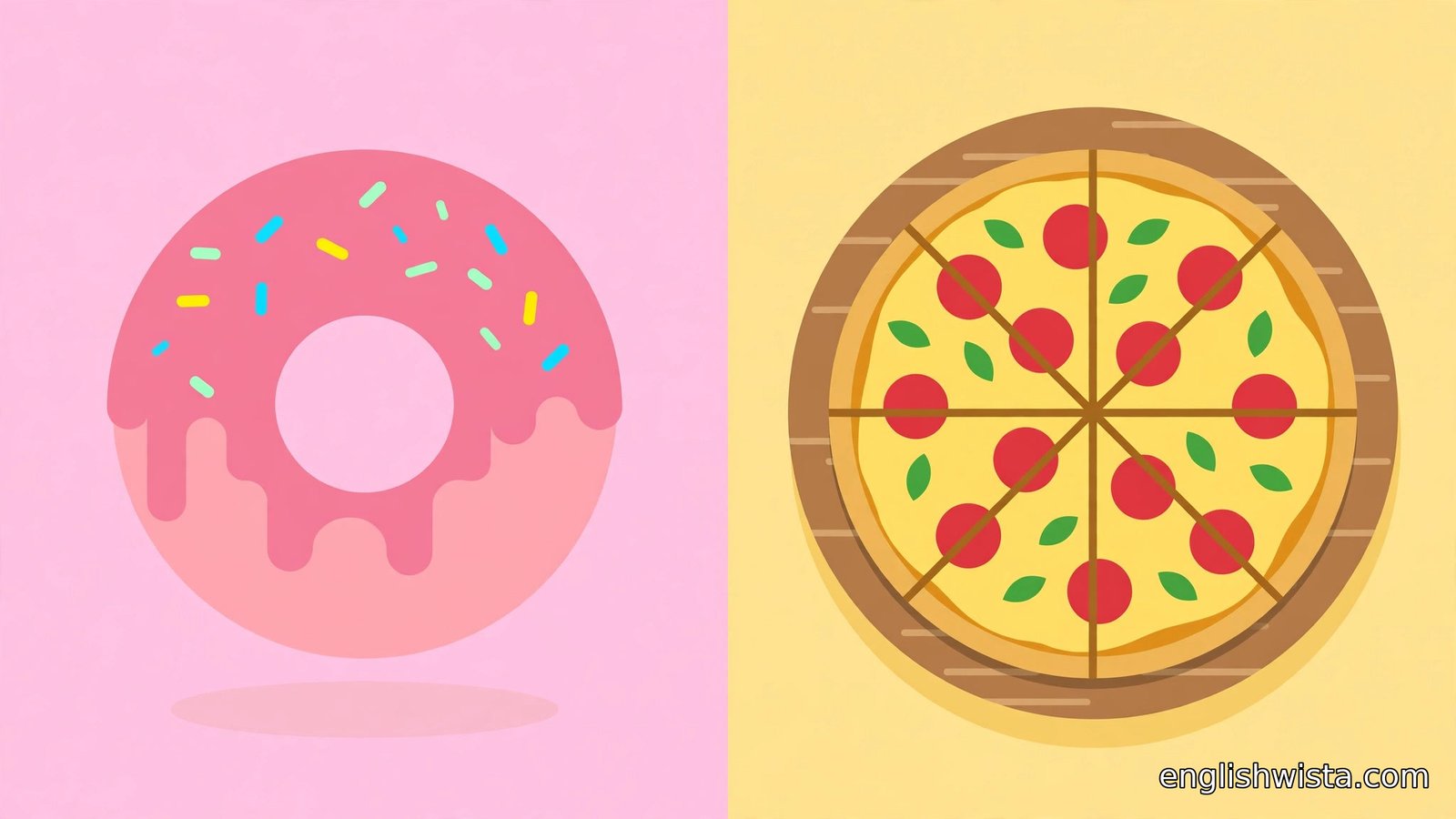
The simple difference is this: a hole is an empty opening in something, like in a donut or a sock; whole means all of something, complete and unbroken. So a donut has a hole in the middle, and you can eat the whole donut. Remember: a hole is empty, whole means all.
Hole: The Empty Space Word
A hole is an opening, gap, or empty space in something solid. Think of the hole in a donut, a hole in the ground, or a hole in your pocket.
- The donut has a big hole in the middle.
- A rabbit jumped out of a hole in the garden.
- There is a hole in my sock that needs fixing.
Whole: The Complete Word
Whole means entire, complete, or all of something — nothing missing. You can talk about a whole day, a whole pizza, or your whole family.
- She ate the whole pizza by herself.
- The whole class went on the school trip.
- It took him a whole week to finish the book.
The Easy Trick to Remember
- Whole starts with “w” — think “whole = with everything”.
- Hole has no “w” — and something with a hole is not whole.
- Think of a donut: the hole is the empty middle, and the whole donut is everything around it.
- Say it as a rhyme: “A hole takes away, but whole means all will stay.”
Example Pairs
- He dug a deep hole to plant the tree. / The whole garden looked beautiful in spring.
- A mouse ran through a hole in the wall. / She read the whole story in one night.
- The shirt has a small hole near the pocket. / The whole team celebrated the win.
Common Mistakes to Avoid
Wrong: He ate the hole cake in ten minutes.
Right: He ate the whole cake in ten minutes.
Wrong: The whole in the wall lets in cold air.
Right: The hole in the wall lets in cold air.
Wrong: I waited for a hole hour in the rain.
Right: I waited for a whole hour in the rain.
Frequently Asked Questions
Are “hole” and “whole” pronounced the same? Yes. Both are pronounced like “hole”, so the spelling is your only clue.
Can “whole” mean something else? “Whole” can also mean healthy or unbroken, as in “the patient is whole again”. But the “complete or entire” meaning is the most common.
What is the plural of “hole”? Just add an “s”: “holes”. For example, “the cheese has small holes in it”.

Mini Quiz: Test Yourself
- 1. The mouse disappeared into a ___ under the fence.
- 2. Our ___ family went to the beach last Sunday.
- 3. He stayed awake the ___ night before the exam.
- 4. There is a ___ in the roof, and rain is coming in.
- 5. She saved the ___ box of chocolates for her friend.
Answers: 1. hole, 2. whole, 3. whole, 4. hole, 5. whole.

Quick Recap
- Hole = an empty opening or gap (think: the middle of a donut).
- Whole = complete, entire, all of something (think: everything).
- Both sound like “hole” — the extra “w” is silent.
- Memory clue: whole starts with w like “with everything”.
Conclusion
Now you can tell them apart with confidence: a hole is an empty space, and whole means complete. Just remember the donut — the hole is the empty middle, and the whole donut is the full treat.