Have you ever noticed how many words in English begin with the letter R? It’s a powerful letter. When you say it, your tongue curls a little, and the sound rolls right out. And when it comes to nouns, words that name people, places, things, or ideas, the letter R gives us a treasure chest of options for everyday use.
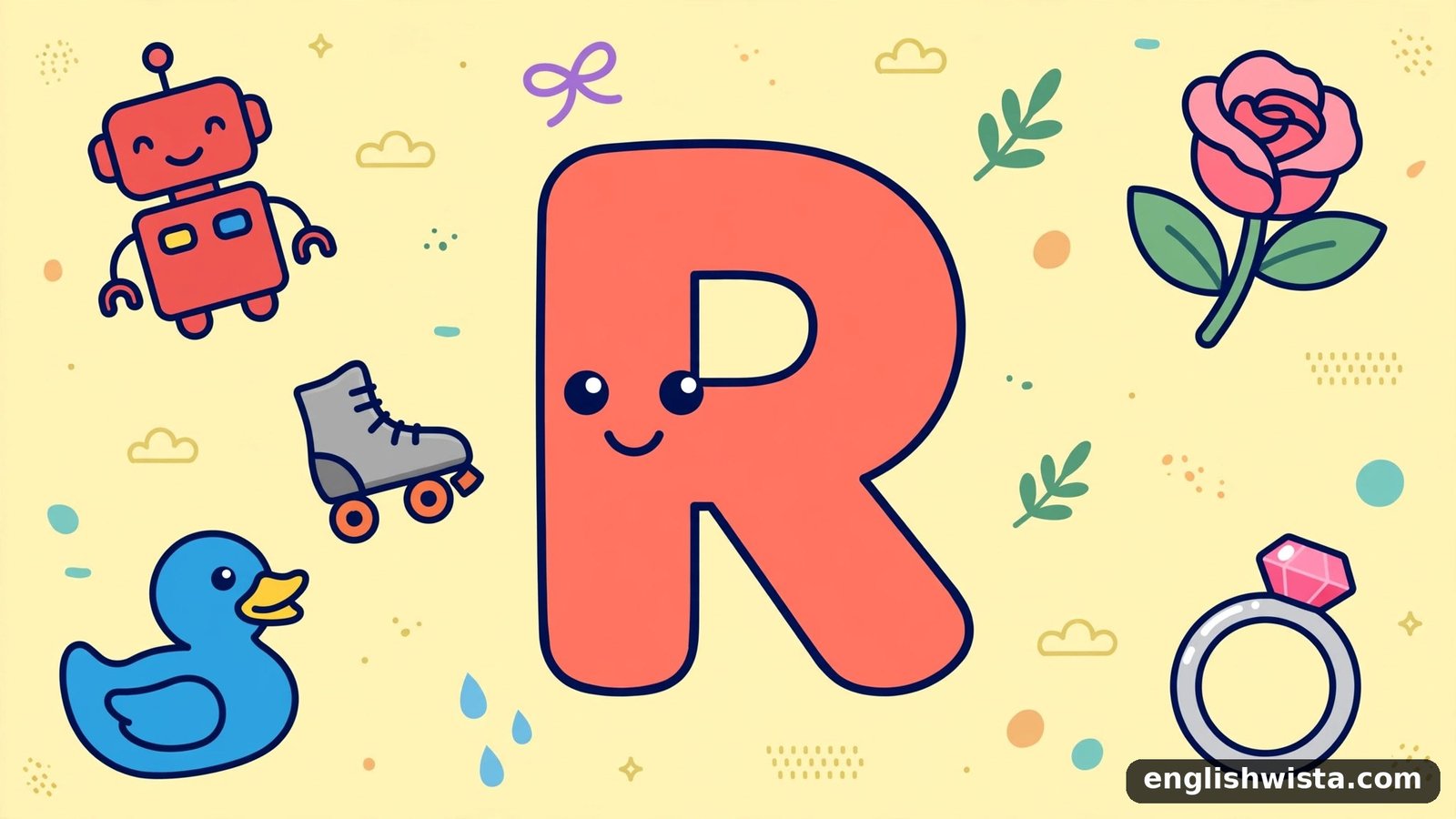
In this article, we’re going to explore nouns that start with R in a simple, step-by-step way. Whether you’re learning English as a new language or just brushing up on grammar basics, this guide is for you. Don’t worry we’ll keep it friendly and fun, with examples, explanations, and even a few fun facts along the way.
So grab a cup of tea or coffee, and let’s dive into the world of R nouns together.
What Are Nouns?
Before we zoom in on R, let’s remind ourselves what a noun actually is.
A noun is a word that names something, and it’s one of the most useful parts of speech you’ll ever learn. It can be:
- A person (teacher, doctor, Rachel)
- A place (park, river, Rome)
- A thing (table, radio, robot)
- An idea (respect, relief, risk)
So, nouns are everywhere in daily conversation. If you can name it, chances are it’s a noun – and the example sentences below prove it. Easy, right?
Why Focus on Nouns That Start with R?
You might be wondering, “Why only R?” Well, sometimes narrowing things down helps you learn better and expand your vocabulary. Instead of looking at hundreds of random nouns, we’ll practice with one letter. R gives us plenty of variety, from everyday words like room to more unusual ones like rendezvous.
By focusing on R nouns, you’ll:
- Expand your vocabulary step by step.
- See how the same letter connects many words.
- Build confidence with real-life examples.
Common Nouns That Start with R
Let’s start with some easy common nouns that start with R. These concrete nouns are words you’ll hear often in everyday use.
- Rabbit – a small animal with long ears.
- Rain – water falling from the sky.
- Road – the path where cars drive.
- Room – part of a house or building.
- River – a natural flow of water.
- Radio – a device for listening to broadcasts.
- Rose – a beautiful flower.
These are all simple and useful nouns. You probably already use some of them without thinking.
Example Sentences:
- The rabbit hopped across the garden.
- Heavy rain fell last night.
- We drove on a long road to the village.
- My bedroom is the biggest room in the house.
- The river flows through the city.
- I listen to music on the radio every morning.
- She gave me a red rose for my birthday.
Proper Nouns Starting with R
Now let’s talk about proper nouns. These are names of specific people, places, or things. They always begin with a capital letter.
Examples:
- Rachel – a person’s name.
- Rome – the capital of Italy.
- Russia – a country.
- Rio de Janeiro – a famous city in Brazil.
- Rolex – a brand name.
Example Sentences:
- Rachel is my best friend.
- We visited Rome last summer.
- Russia is the largest country in the world.
- The carnival in Rio de Janeiro is world-famous.
- He bought a new Rolex watch.
Abstract Nouns with R
Not all nouns are things you can touch. Some nouns are ideas or feelings. These are called abstract nouns.
Examples:
- Respect – a feeling of admiration.
- Relief – the easing of stress or pain.
- Risk – the possibility of loss or danger.
- Reason – the cause or explanation of something.
- Romance – a feeling of love.
Example Sentences:
- Treat everyone with respect.
- She sighed with relief after the exam.
- Starting a new business is always a risk.
- There’s a good reason for his late arrival.
- They enjoy reading novels filled with romance.
Countable and Uncountable R Nouns
Nouns can be countable (things we can count) or uncountable (things we cannot count easily). Let’s look at both types.
- Countable R Nouns: rabbit, ring, robot, room, rose.
- Uncountable R Nouns: rice, rain, rubbish, respect.
Example Sentences:
- I saw three rabbits in the park. (countable)
- Please give me a bowl of rice. (uncountable)
- She wears two rings on her fingers. (countable)
- Too much rubbish is on the street. (uncountable)
Plural Forms of R Nouns
Now you might ask, “How do I make R nouns plural?” Most follow the regular rule of adding -s.
- Rabbit → Rabbits
- Ring → Rings
- Room → Rooms
Some nouns change spelling:
- Roof → Roofs (not rooves)
- Radio → Radios
- Recipe → Recipes
Example Sentences:
- The farmer has many rabbits.
- She bought two gold rings.
- There are five rooms in the house.
- I collected three delicious recipes.
Fun R Nouns from Nature
Nature is full of nouns beginning with R. Here are some beautiful ones:
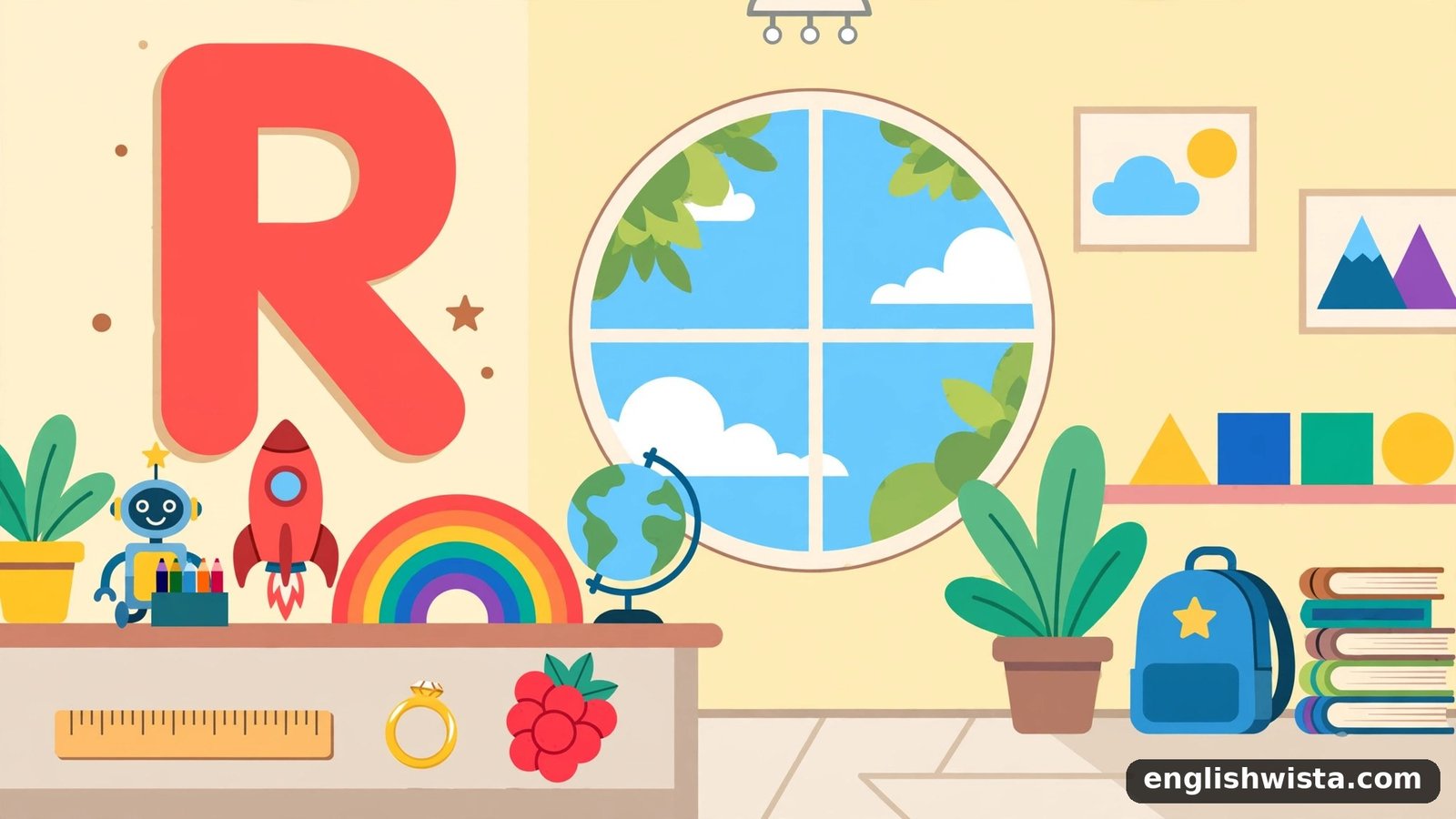
- Rainbow – colors in the sky after rain.
- Reef – a ridge in the sea, often of coral.
- Rock – a solid piece of stone.
- Root – the part of a plant under the ground.
- Rainforest – a dense forest with heavy rainfall.
Example Sentences:
- The rainbow appeared after the storm.
- Fish swim near the coral reef.
- He threw a rock into the lake.
- The tree’s roots spread wide.
- Many animals live in the rainforest.
R Nouns for Everyday Life
Here are some nouns that you might use every day to describe things around you:
- Recipe – instructions for cooking.
- Receipt – proof of a purchase.
- Report – written or spoken information.
- Reminder – something that helps you remember.
- Reward – something given in return for effort.
Example Sentences:
- I tried a new cake recipe.
- Keep the receipt in case you need to return it.
- The teacher asked for a book report.
- I set a reminder on my phone.
- Hard work often brings a big reward.
Rare and Interesting R Nouns
Not all R nouns are common. Some are unusual but fun to learn:
- Rendezvous – a planned meeting.
- Revelation – a surprising discovery.
- Rebellion – resistance against authority.
- Riddle – a puzzling question.
- Replica – a copy of something.
Example Sentences:
- They planned a secret rendezvous.
- His words were a shocking revelation.
- The people started a rebellion.
- Can you solve this riddle?
- The museum showed a replica of the old ship.
Collective Nouns with R
Collective nouns describe groups. Here are some R examples:
- A raft of ducks.
- A rush of crocodiles.
- A rhumba of rattlesnakes (yes, it’s real!).
Example Sentences:
- A raft of ducks flew over the pond.
- Tourists saw a rush of crocodiles in the river.
- The desert hides a rhumba of rattlesnakes.
Fun Facts About R Nouns
- The word robot comes from the Czech word robota, meaning “forced labor.”
- Rainbow has been a symbol of hope and promise in many cultures.
- The noun Rome is also called “The Eternal City.”
- Rose is not only a noun but also one of the most popular names for girls.
- Rendezvous comes from French and literally means “present yourselves.”
Quick Vocabulary List of R Nouns
Here’s a full word list – a mini dictionary for easy review and vocabulary building:
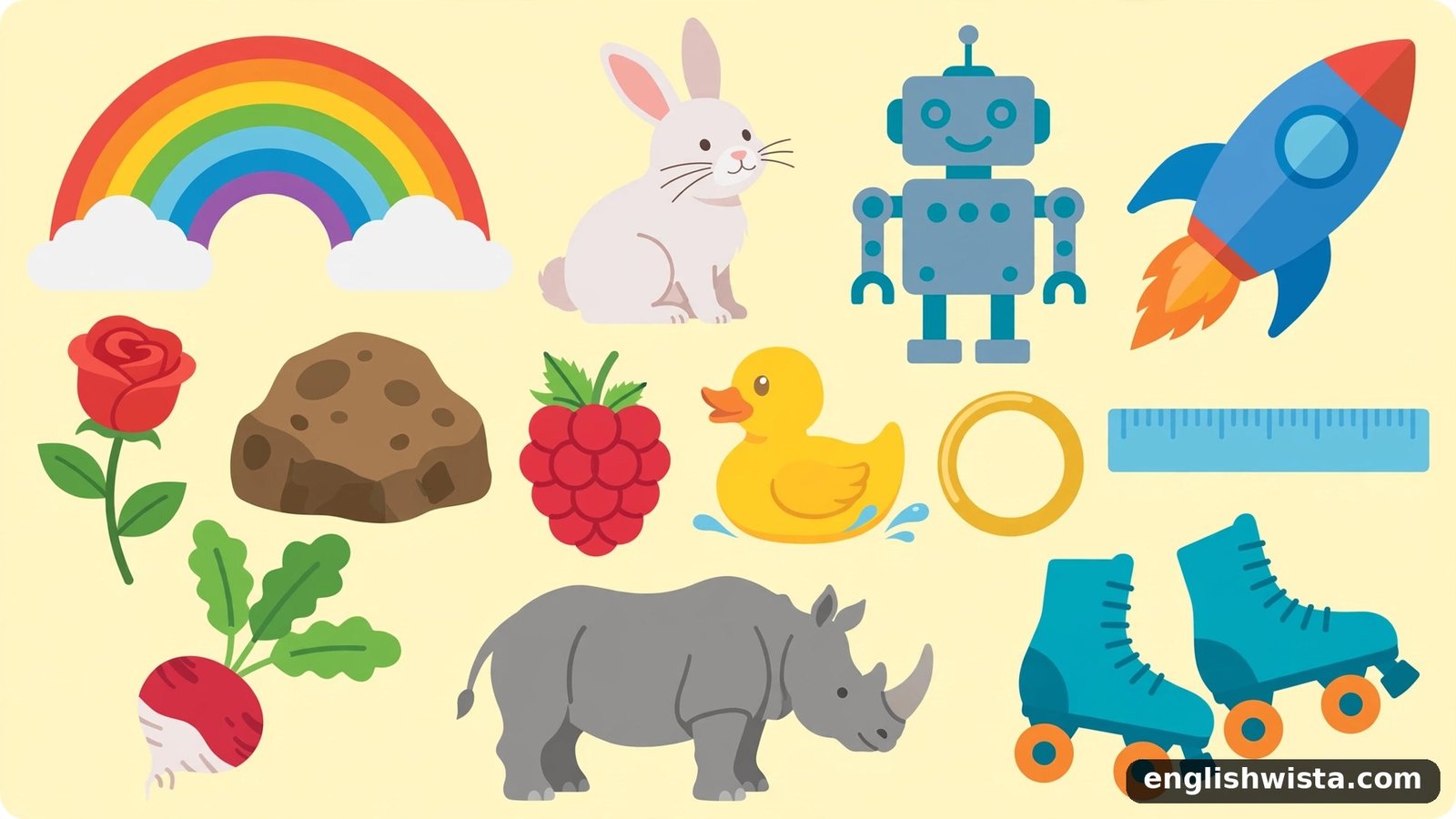
- Rabbit
- Rain
- Road
- Room
- River
- Radio
- Rose
- Rachel
- Rome
- Russia
- Respect
- Relief
- Risk
- Rainbow
- Rock
- Recipe
- Receipt
- Report
- Rendezvous
- Replica
(And many more!)
Conclusion
We’ve taken a fun journey through the complete list of nouns starting with the letter R – a great milestone for ESL students and English learners. From rabbits and rainbows to respect and rendezvous, R gives us a wide range of words. We saw:
- Everyday nouns (rabbit, rain, room).
- Proper nouns (Rome, Rachel).
- Abstract nouns (respect, relief).
- Countable and uncountable nouns.
- Fun and unusual ones (rendezvous, riddle).
Learning nouns is like building blocks for your language. The more you know, the easier it becomes to speak, write, and understand English.
So next time you hear an R word, remember it might just be a noun you can add to your collection. Keep practicing, keep exploring, and soon these words will roll off your tongue as smoothly as the letter R itself.
Common Mistakes with R Nouns
Even confident learners slip up with R nouns. Here are the most common traps. Noun-or-not lookalikes: “ready,” “right,” and “round” can all be adjectives, so in “the ready team,” ready describes the noun instead of being one. “Record” is a noun with first-syllable stress (RE-cord, a music disc) but a verb with second-syllable stress (re-CORD, to capture sound). Words often mislabeled as nouns: “running” and “raining” are verb forms, even though they name activities – use “run” and “rain” when you need the plain noun. Quick-fix pairs: recipe (cooking instructions) vs. receipt (proof of payment) sound alike but mean very different things. Rain vs. reign vs. rein: only the first is weather. Role vs. roll: a role is a part you play; a roll is bread or a turning motion. When in doubt, check a dictionary for the “n.” label – it confirms the word is truly a noun.
Frequently Asked Questions
What are nouns that start with R?
Nouns that start with R are naming words beginning with the letter R – from everyday words like “rabbit,” “rain,” and “room” to bigger ideas like “respect” and “revelation.” They include common nouns, proper nouns like “Rome,” abstract nouns like “relief,” and even collective nouns like “a raft of ducks.” This article walks you through all of them.
What are 10 common nouns that start with R?
Ten common R nouns for everyday use: rabbit, rain, road, room, river, radio, rose, recipe, report, and rock. Most form plurals by simply adding -s (rabbit becomes rabbits). Use them to describe things around you – “The road runs past the river” – and they’ll become second nature.
What are proper nouns that start with R? (cities, countries, famous people)
Popular R proper nouns include cities like Rome and Rio de Janeiro, countries like Russia and Romania, famous people like Rihanna and Rembrandt, and brands like Rolex and Ray-Ban. Remember the capitalization rule: proper nouns always start with a capital letter, while common nouns like “river” don’t.
What are abstract nouns that start with R?
Abstract R nouns name ideas and feelings you can’t touch: respect, relief, risk, reason, revelation, and rebellion. They’re common in deeper conversations – “She felt relief after the exam.” Pair each one with a concrete example sentence to remember its meaning.
What are some positive nouns that start with R?
Uplifting R nouns include respect, relief, reward, radiance, and resilience. Many are abstract nouns that describe good feelings or strengths. Try describing a person you admire with one – “His resilience inspires me” – to practice using positive words naturally.