
Do you ever write “principal” and pause, wondering if it should be “principle”? You are not alone! These two sound almost identical and even share the same origin — but they mean completely different things. Mixing them up is a classic English mistake, even for native speakers. Today, we will clear it up once and for all with a simple rule and easy examples you can actually remember.
Table of Contents
- What Is the Simple Difference?
- Principal: The Main Person or Thing
- Principle: A Rule or Belief
- The Easy Trick to Remember
- Principal vs Principle in Example Sentences
- Common Mistakes to Avoid
- Frequently Asked Questions
- Mini Quiz: Test Yourself
- Quick Recap
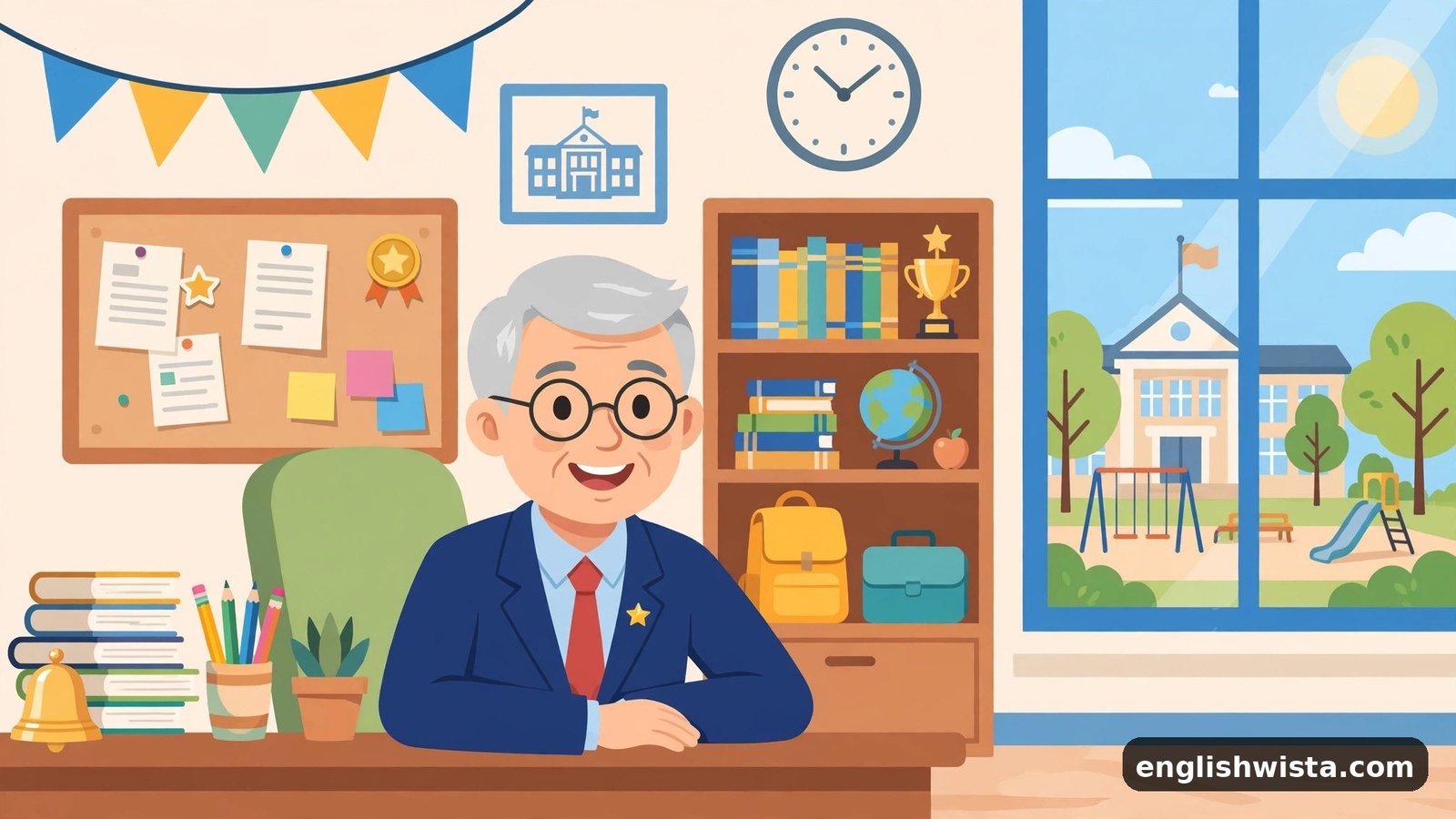
What Is the Simple Difference?
Here is the short answer you can use almost every time:
- Principal = the main person or thing (a school head, a sum of money, the most important).
- Principle = a rule, belief, or basic truth (moral principles, scientific principles).
Think of it this way: principal ends like “pal” — a person (your pal, the school head). Principle ends like “rule” — a rule to follow.
Principal: The Main Person or Thing
Use principal for the head of a school, the main amount of money (not interest), or simply “the most important.”
- The principal announced the new school rules. (Head of the school.)
- She paid back the principal of the loan. (The main sum, not the interest.)
- The principal reason for his success is hard work. (The main reason.)
- He is the principal dancer of the company. (The leading dancer.)
As an adjective, principal always means “main” or “chief”: principal idea, principal city, principal ingredient.
Principle: A Rule or Belief
Use principle for a fundamental rule, moral belief, or scientific truth. It is always a noun — never an adjective.
- He refused to lie as a matter of principle. (A moral rule.)
- The principle of gravity affects everything. (A scientific truth.)
- She sticks to her principles no matter what. (Her beliefs.)
- The principle behind the plan is simple: help everyone. (The basic idea.)
If you can put “rule” or “belief” in its place, principle is your word.
The Easy Trick to Remember
Here is a trick that never fails. Look at the ending:
- Principal → your pal is a person (the school principal is your pal!).
- Principle → ends like rule (a principle is a rule).
Try it:
- “The school princi-pal is my pal.” — person! Correct!
- “A matter of princi-ple, like a rule.” — rule! Correct!
Pal = person, ple = rule — that is the whole secret!
Principal vs Principle in Example Sentences
Let us look at real-life pairs side by side:
- The principal gave a speech. / Honesty is his guiding principle.
- Our principal export is wheat. / Fairness is our guiding principle.
- She is the principal singer. / She sings on principle, never for fame.
- The principal of the investment grew. / He invests according to his principles.
In each pair, principal = main person/thing and principle = rule or belief.
Common Mistakes to Avoid
Mistake 1: “Principle” for the school head.
- Wrong: “The principle called my parents.”
- Right: “The principal called my parents.” (Your pal — the person!)
Mistake 2: “Principal” for a moral rule.
- Wrong: “He has strong principals.”
- Right: “He has strong principles.” (Rules he lives by.)
Mistake 3: Using “principle” as an adjective. Only principal can be an adjective: “the principal reason.” “The principle reason” is always wrong.
Frequently Asked Questions
Are they pronounced the same? Almost — both sound like “PRIN-suh-pul.” The tiny difference in the last syllable is so small that most speakers say them identically. That is exactly why the spelling trick matters.
Can “principal” be a noun and an adjective? Yes! Noun: the school head, the main sum of money. Adjective: the main thing (“principal cause”). Principle, on the other hand, is only ever a noun.
What does “on principle” mean? It means “because of a moral rule”: “She refused the gift on principle.” It is always spelled principle — think “rule.”
Is there a plural difference? Principals = several school heads (or main sums). Principles = several rules or beliefs. Same trick applies to the plurals!
Mini Quiz: Test Yourself
Choose principal or principle for each sentence.
- 1. The school _____ is very kind.
- 2. Honesty is my guiding _____.
- 3. What is the _____ idea of the book?
- 4. He would not cheat as a matter of _____.
- 5. The _____ amount must be repaid first.
Answers: 1. principal (the person — your pal!) 2. principle (a moral rule) 3. principal (adjective = main) 4. principle (a rule he lives by) 5. principal (the main sum of money)
Quick Recap
- Principal = main person or thing (pal = person). Can be noun or adjective.
- Principle = rule, belief, or basic truth (ple = rule). Noun only.
- School head → principal. Moral rule → principle.
- Only principal works as an adjective (“principal reason”).
- “On principle” is always spelled with -ple.
Conclusion
So, principal or principle? Now you know: principal is your pal (the main person or thing), and principle is a rule. With the pal/person, ple/rule trick in your pocket, you will never mix them up again. Keep practicing with real sentences, and soon the right word will come to you automatically!