Have you ever written “waiver” when you meant “waver”? You are not alone! These two words sound similar but one is a verb about hesitating, and the other is a noun about a signed document. Today, we will explain exactly what waver vs waiver means, with a simple trick to remember it forever.

What Is the Simple Difference?
Waver is a verb — to shake, hesitate, or become unsteady.
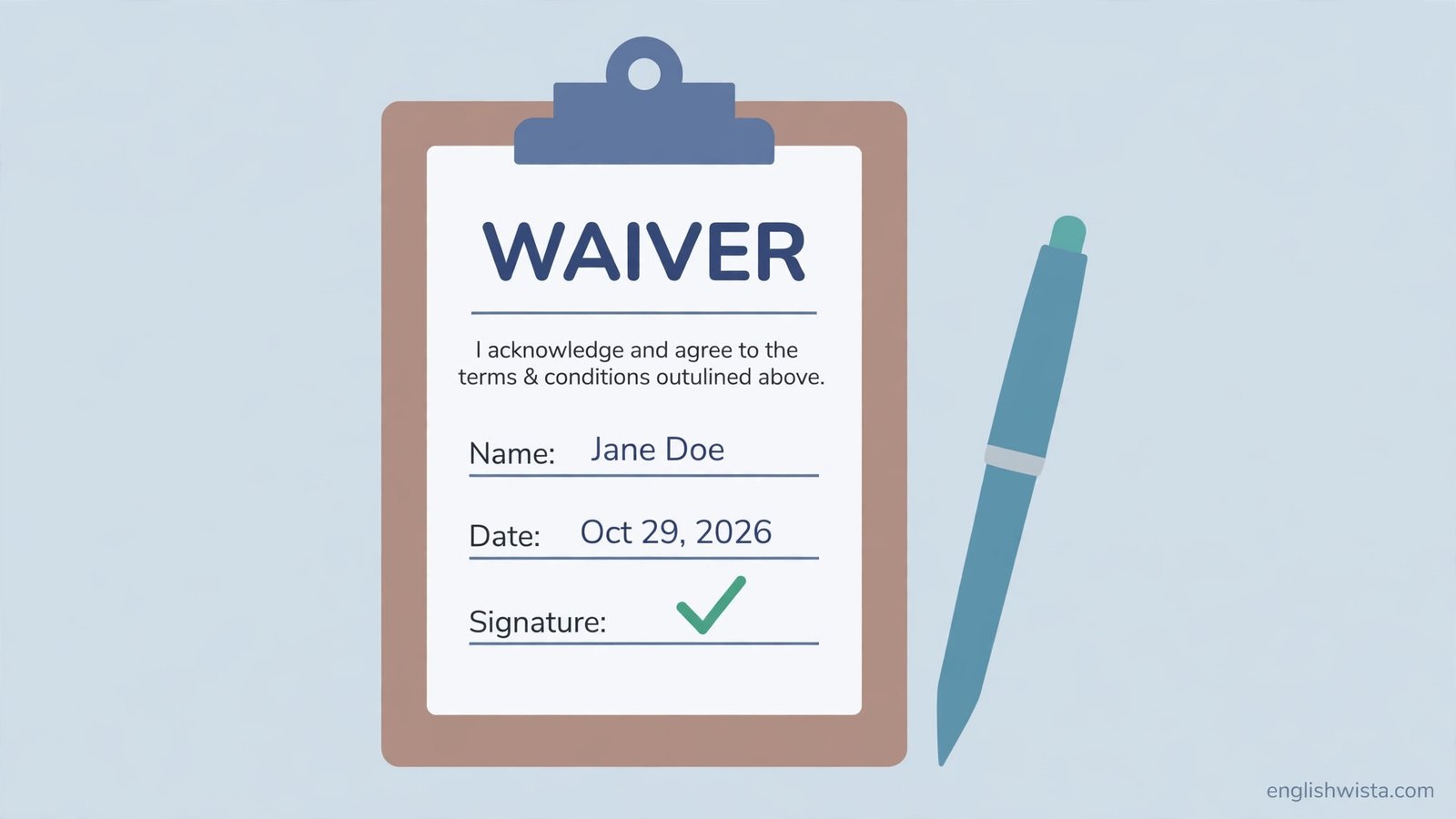
Waiver is a noun — a signed document giving up a right or claim.
- Waver (verb) = hesitate / wobble.
- Waiver (noun) = a written release / permission slip.
Think of it this way: your voice wavers when you are nervous; you sign a waiver before skydiving.
Waver: To Hesitate or Become Unsteady
Waver means to shake or hesitate — your voice, your confidence, or a flag in the wind can waver.
- “Her voice wavered as she spoke.” (it shook)
- “Do not waver — stay confident!” (do not hesitate)
- “The flag wavered in the wind.” (it rippled unsteadily)
If it means shake, hesitate, or be unsteady, it is waver — an action, so it is a verb.
Waiver: A Signed Document
Waiver is a written document in which you give up a right or agree not to claim something — like a form you sign before sports or travel.
- “We signed a waiver before the boat trip.”
- “The gym asked me to fill out a waiver.”
- “She got a fee waiver for the exam.” (the fee was given up)
If it is a paper or form you sign, it is waiver — a thing, so it is a noun.
The Easy Trick to Remember
- Waver ends like “wav” + “er” — think of a wave moving back and forth. Hesitating is like rocking back and forth.
- Waiver contains “waive” — to waive a right means to give it up, and a waiver is the paper that proves it.
Waver = WAVE back and forth (verb, hesitate). Waiver = WAIVE your right (noun, signed paper). Root words do the work!
Example Pairs
- Waver: “His courage never wavered.” / Waiver: “He signed the liability waiver.”
- Waver: “The candle flame wavered in the breeze.” / Waiver: “The school sent home a photo waiver.”
- Waver: “She did not waver in her decision.” / Waiver: “They gave us a waiver to sign.”
Common Mistakes to Avoid
Mistake 1: Writing “waiver” for hesitating.
- Wrong: “She never waiver in her beliefs.”
- Right: “She never wavers in her beliefs.”
Mistake 2: Writing “waver” for the signed form.
- Wrong: “Please sign this waver.”
- Right: “Please sign this waiver.”
Mistake 3: Forgetting the part of speech. Waver is always an action (verb) — “he wavers.” Waiver is always a thing (noun) — “the waiver.” If you can hold it, it is waiver!
Frequently Asked Questions
Can “waver” mean waving your hand? No — that is “wave.” Waver means to become unsteady or hesitate, as in “Her voice wavered during the speech.”
Do you sign a waiver to give up rights? Often yes — gyms and event organizers use waivers where you agree not to hold them legally responsible for injuries.
What is a “waiver wire” in sports? A system where teams can claim a player that another team has released — the first team “waives” (gives up) its claim on the player.
Mini Quiz: Test Yourself
Choose the best answer for each question.
- 1. His voice ______ with emotion.
- 2. Please sign the ______ before entering.
- 3. Which word is a verb meaning “to hesitate”?
- 4. True or false: “Sign the waver at the desk” is correct.
- 5. Which word is a noun you can sign?
Answers: 1. wavered 2. waiver 3. waver 4. False — it is “waiver” 5. waiver

Quick Recap
- Waver = verb: to hesitate, shake, or become unsteady.
- Waiver = noun: a signed document giving up a right.
- Trick: waver = WAVE (rock back and forth); waiver = WAIVE (give up a right).
- Action = waver; paper = waiver.
Conclusion
So, waver vs waiver: waver is the verb for hesitating, waiver is the signed paper. Action = waver, paper = waiver — and you will never mix them up again!