Have you ever written a word quickly and then stopped to wonder, “Wait, was that right?” Words in English are full of commonly confused words that look and sound similar, but their meanings can be very different. A classic example is “coach” vs “couch.”

At first glance, these two words seem close enough to be cousins. They both start with a “co” and end with a “ch.” But don’t let their spelling trick you they belong to completely different families of meaning. One relates to guidance and teaching, while the other is about comfort and furniture.
If you’ve ever confused the two, don’t worry. Many English learners, and even native speakers, slip up with these words. That’s why in this article, we’ll take a friendly walk through the world of coach and couch. We’ll explore what they mean, how to use them, where they came from, and even look at some fun facts. By the end, you’ll feel confident knowing when to use each word.
Let’s jump in.
What Does “Coach” Mean?
The word coach is like a Swiss army knife it has many uses.
- A Person Who Trains or Guides:
- A coach is someone who helps people improve in a skill. This could be in sports, life, or even business.
- Example: The football coach taught the players new strategies.
- A Type of Vehicle:
- A coach can also mean a bus, especially one used for long-distance travel.
- Example: We took a coach from London to Manchester.
- An Old-Fashioned Carriage:
- In history, a coach was a horse-drawn carriage used before cars were invented.
- Example: The royal family arrived in a golden coach.
So, when you hear the word “coach,” think about teaching, guiding, or a type of transport. Context will tell you which meaning is being used.
What Does “Couch” Mean?
Now let’s turn to couch. This word has a much cozier meaning.
- A Piece of Furniture:
- A couch is a long, padded seat where several people can sit or one person can lie down. Its most common synonym is “sofa.”
- Example: She curled up on the couch to watch her favorite movie.
- As a Verb (Less Common):
- To couch something means to express it in a particular way. This use is less common in daily speech but you might see it in books or formal writing.
- Example: He couched his criticism in polite words.
Most of the time, when people say “couch,” they mean the comfy piece of furniture in the living room.
Why Do People Confuse “Coach” and “Couch”?
It’s easy to mix them up because:
- They look almost the same just one letter apart.
- They sound alike, especially in fast speech.
- Both words are nouns whose parts of speech overlap — each can even act as a verb — which adds to the confusion.
However, their meanings are worlds apart. Here’s a quick memory trick — a handy mnemonic to keep them straight:
- Coach = teaching, training, or travel.
- Couch = sitting, relaxing, or furniture.
Example Sentences to Show the Difference
Here are some side-by-side example sentences to make things clear:
- The coach helped me improve my tennis serve. (trainer)
- I fell asleep on the couch after dinner. (furniture)
- We traveled by coach to the city. (bus)
- Our cat sleeps on the couch all day. (sofa)
- The king rode in a grand coach during the parade. (carriage)
- He couched his request in very formal language. (expressed)
Notice how the context — the other words around it in a sentence — makes the meaning obvious.
Is “Coach” Singular or Plural?
Like most nouns, “coach” has both singular and plural forms.
- Singular: The coach is giving instructions.
- Plural: The coaches are planning the training session.
Is “Couch” Singular or Plural?
The same rule applies to “couch.”

- Singular: That couch looks very comfortable.
- Plural: We bought two couches for the lounge.
The Origins of “Coach”
The word “coach” comes from the Hungarian town of Kocs, famous in the 15th century for its carriages. These vehicles became known in English as “coaches.” Later, the meaning expanded to teachers and trainers, because they “carried” students from one level to another just like a coach carried passengers.
The Origins of “Couch”
“Couch” comes from the Old French word coucher, meaning “to lie down.” That explains why we use it to describe a piece of furniture you can lie on. The word kept its cozy, resting-related meaning through the centuries.
Fun Facts About Coach
- In sports, a coach can also be called a manager (like in soccer/football).
- In airlines, “coach class” means economy class seating the cheaper option compared to business or first class.
- “Coaching” is now a huge industry, covering life coaching, career coaching, and even confidence coaching.
Fun Facts About Couch
- Some people say “sofa,” while others say “couch.” Both are correct — it’s a matter of formal vs everyday usage — but “sofa” sounds a little more formal.
- The idiom “couch potato” describes someone who spends a lot of time sitting or lying on the couch watching TV.
- In psychology, the “analyst’s couch” is famous because therapists used to have patients lie on a couch during sessions.
Quick Comparison Table
| Word | Main Meaning | Extra Meanings | Example Sentence |
|---|---|---|---|
| Coach | Trainer, guide, or long-distance bus | Old carriage; economy class (air travel) | The coach gave me helpful advice. |
| Couch | Sofa or padded seat | To phrase something carefully | She bought a new couch for the living room. |
Tips to Remember the Difference
- Think of coach as movement and guidance. A coach helps you move forward or carries you somewhere.
- Think of couch as rest and comfort. A couch is where you stop moving and relax.
Common Phrases With “Coach”
- Life coach → someone who helps with personal growth.
- Head coach → the main trainer of a sports team.
- Coach class → standard seats on a plane.
Common Phrases With “Couch”
- Couch potato → a lazy person who sits around.
- Couch surfing → staying temporarily on someone’s couch while traveling.
- Therapist’s couch → the place where people lie down during counseling.
Practice Time
Here’s one of our favorite practice tips: test your memory with a quick exercise. Which word fits?
- The football ________ planned today’s training.
- She fell asleep on the ________ after lunch.
- We took a ________ to another city.
- He couched his request in kind words.
- The old royal ________ is displayed in the museum.
(Answers: 1. coach, 2. couch, 3. coach, 4. couched, 5. coach)
Common Mistakes and How to Avoid Them
Even when you know the meanings, it’s easy to slip in writing. Here are the most common mistakes with this word pair — and how to avoid them:
- Writing “couch” when you mean the trainer. ✗ The couch praised the team. ✓ The coach praised the team. Fix: if the person teaches or trains, it’s a coach.
- Writing “coach” when you mean the furniture. ✗ I fell asleep on the coach. ✓ I fell asleep on the couch. Fix: if you sit or lie on it, it’s a couch.
- Confusing the verb form. ✗ She couched on the sofa. ✓ She couched her request in polite words. Fix: as a verb, “couch” means “to express carefully” — never “to sit.”
- Misspelling the plurals. ✗ Two coachs waited outside. ✓ Two coaches waited outside. Fix: both words add -es — coaches, couches.
Conclusion
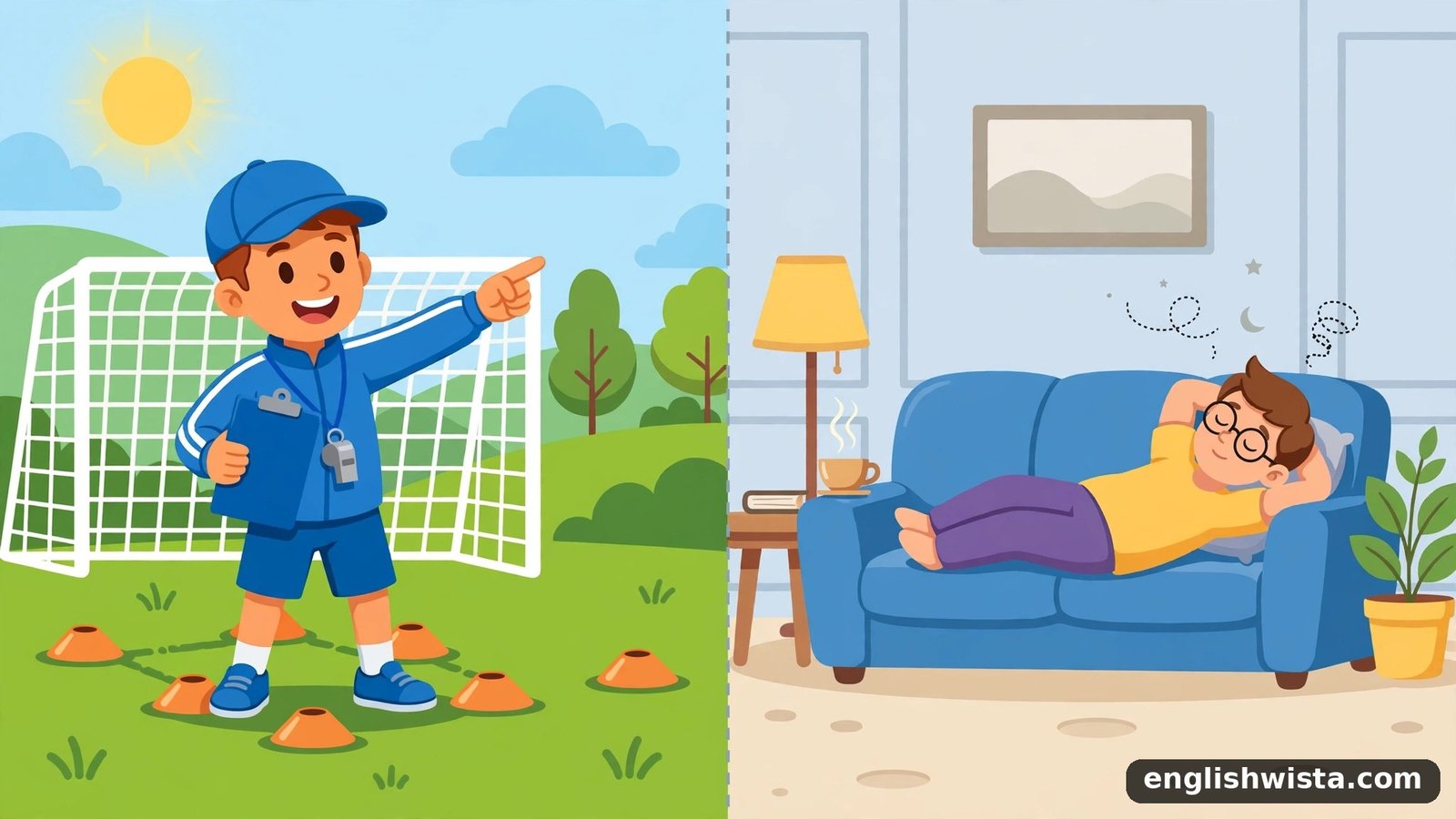
English can be tricky, but it’s also full of fascinating stories. The words coach and couch may look similar, but now you know their differences clearly. A coach helps you learn, guides you, or takes you somewhere. A couch is the soft place where you rest after all that learning and traveling.
The next time you’re writing or speaking, just remember: “A coach moves you forward, a couch holds you still.” With that little trick, you’ll never confuse them again.
So, whether you’re working with a coach or relaxing on your couch, you’ve got these two words under control.
Frequently Asked Questions
What is the difference between coach and couch?
A coach is a person who trains or guides others — or a long-distance bus — while a couch is a soft piece of furniture you sit or lie on. These commonly confused words look and sound alike, but their meanings are completely different, so always check the context before choosing one.
Is coach a noun or a verb?
It can be both. As a noun, it means a trainer, a bus, or an old-fashioned carriage; as a verb, it means to train or guide someone, as in She coaches the tennis team. Couch is mainly a noun, though it can also be a verb meaning “to express carefully.”
Can couch ever be used as a verb? When?
Yes, but this use is rare and mostly appears in formal or literary writing. To “couch” something means to phrase it in a particular way — for example, He couched his criticism in polite words. In everyday conversation, couch is almost always the furniture.
How can I remember the difference between coach and couch?
Try this mnemonic: “A coach moves you forward; a couch holds you still.” A coach trains you, guides you, or carries you somewhere, while a couch is where you stop moving and rest. Quick test: if you can sit on it, it’s a couch; if it teaches you, it’s a coach.