Have you ever written “a piece of cake” and wondered why it is not “a peace of cake”? You are not alone! Peace and piece sound exactly the same but mean completely different things. Today, we will explain the simple difference between peace vs piece, with easy examples, a memory trick, common mistakes, and a mini quiz at the end.
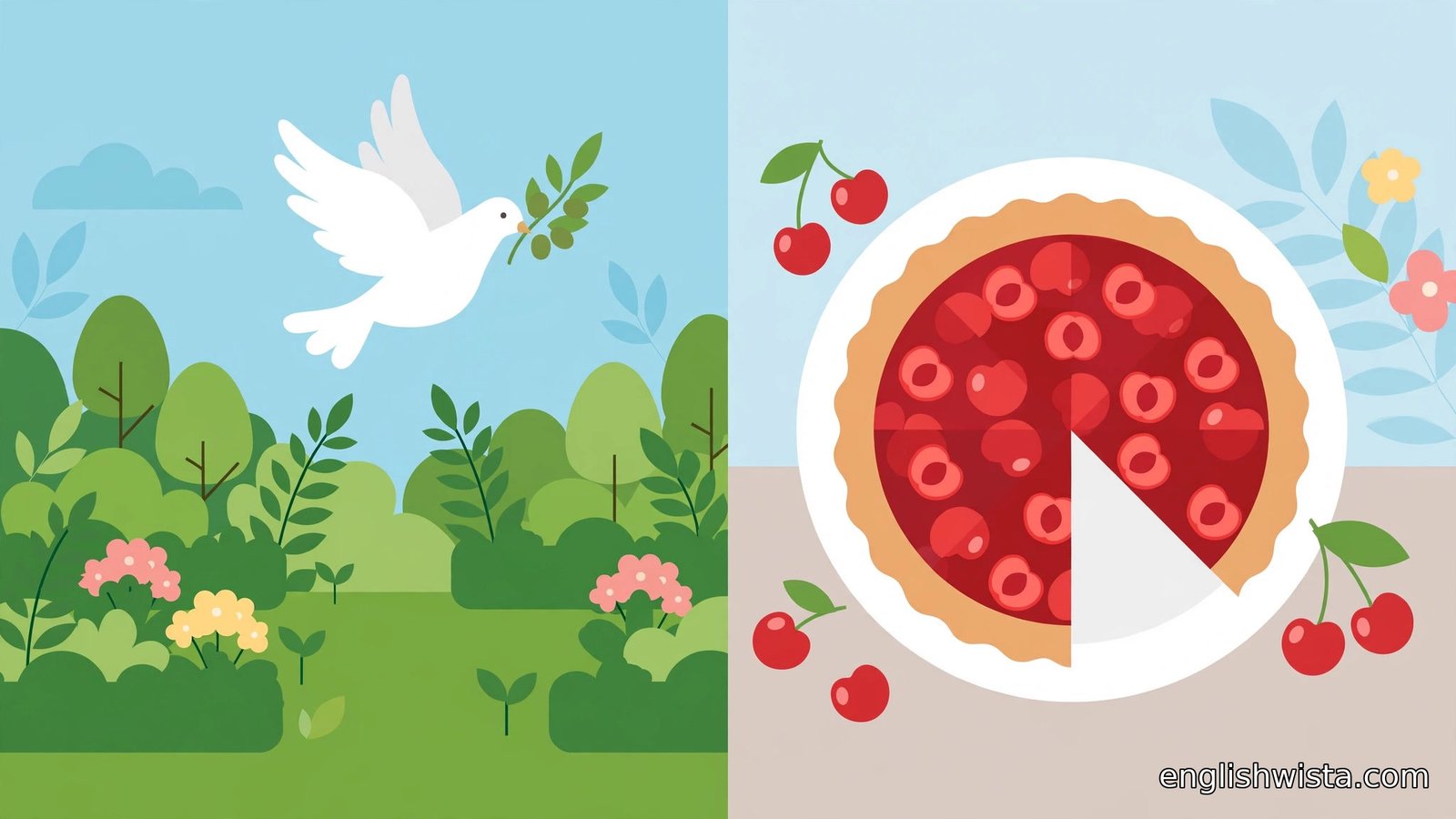
What Is the Simple Difference?
Peace is a noun — calm, quiet, and freedom from war or worry.
Piece is a noun/verb — a part of something bigger (or to put parts together).
- Peace = calm.
- Piece = part.
Think of it this way: peace is what you feel on a quiet morning, and a piece is what you cut from a pie.
Peace: The Calm Word
Peace means calmness, quiet, and the absence of war, fighting, or stress.
- “The world wishes for peace.”
- “She loves the peace of the countryside.”
- “They made peace after the long argument.”
If it is about calm or no fighting, it is peace.
Piece: The Part Word
Piece means a separate part or portion of something larger.
- “I ate a piece of cake.”
- “She picked up the pieces of the broken vase.”
- “He wrote a piece about football.” (an article)
If it is about a part or a portion, it is piece.
The Easy Trick to Remember
- Peace starts with PEA — think of peas in a pod, quiet and calm together.
- Piece has PIE inside it — you eat a PIECE of PIE!
- Peace = calm. Piece = a part of a pie.
Peas in a pod = peace. A piece of pie = piece. That is the whole trick!
Example Pairs
- Peace: “They signed a peace treaty.” / Piece: “He broke a piece of bread.”
- Peace: “I need some peace and quiet.” / Piece: “This is the last piece.”
- Peace: “Rest in peace.” / Piece: “She kept a piece of the letter.”
Common Mistakes to Avoid
Mistake 1: Writing “peace” for a part of food.
- Wrong: “Can I have a peace of cake?”
- Right: “Can I have a piece of cake?”
Mistake 2: Writing “piece” for calmness.
- Wrong: “I just want a piece of mind.”
- Right: “I just want peace of mind.”
Mistake 3: Writing “piece” in the fixed phrase.
- Wrong: “The two sides agreed to keep the piece.”
- Right: “The two sides agreed to keep the peace.”
Frequently Asked Questions
Is “peace” always a noun? Almost always — “peaceful” is its adjective form (“a peaceful garden”).
What does “a piece of the action” mean? A share or part of the benefits — like getting a piece of the pie.
How do you pronounce them? Both sound the same: “PEES.” Only the spelling tells them apart.
Mini Quiz: Test Yourself
Choose the best word for each question.
- 1. “They signed a ______ treaty.” (peace / piece)
- 2. “Can I have a ______ of pie?” (peace / piece)
- 3. “I need some ______ and quiet.” (peace / piece)
- 4. “She picked up the ______ of the broken glass.” (peace / pieces)
- 5. True or false: “peace of cake” is correct.
Answers: 1. peace 2. piece 3. peace 4. pieces 5. False — it is “piece”

Quick Recap
- Peace = calm, no war (PEA = peas in a pod).
- Piece = a part (PIE = a piece of pie).
- They sound identical — spelling is the only difference.
Conclusion
So, peace vs piece: peace is calm, and a piece is a part. Remember peas in a pod and a piece of pie, and you will never mix them up again!