
Have you ever noticed that sometimes people write “centre” and other times you see “center”? If you’ve wondered whether these are two different words or just different spellings of the same word, you’re not alone. Many English learners (and even native speakers) get tripped up by these commonly confused words.

The good news is that both are correct. They sound alike and mean the same thing — the only difference lies in where you are in the world. English is spoken in many countries, and spelling can change depending on the region. Let’s take a closer look at the story behind centre vs center, when to use each one, and some fun facts and a few practice tips that will help you remember them easily.
What Do “Centre” and “Center” Mean?
At their core, both words mean the same thing. Here’s a simple definition:
- Centre/Center: The middle point of something. It can also mean the most important place or the main part of an activity.
Think of the middle of a circle that’s its centre (or center). Or imagine a town square where all the action happens that’s the town centre (or center).
So the meaning doesn’t change. The difference is only in spelling.
Why Are There Two Spellings?
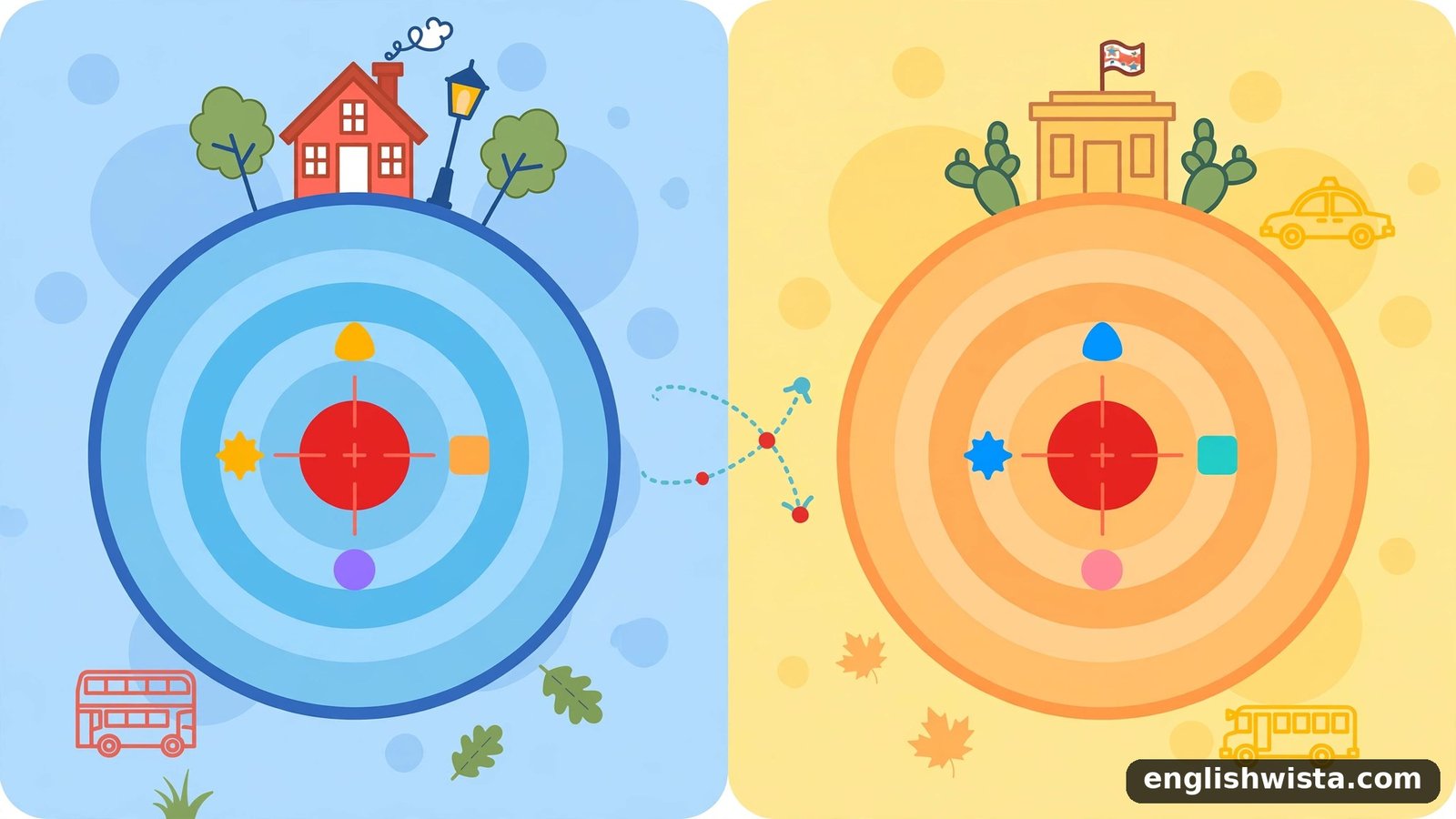
This is where English gets interesting. The difference comes down to British English vs American English.
- Centre is the British English spelling. It is commonly used in the UK, Canada, Australia, India, and other countries that follow British spelling traditions.
- Center is the American English spelling. It is used in the United States and has influenced some other regions too.
So, if you’re reading a book published in London, you’ll probably see “centre.” But if you’re browsing a website from New York, you’ll see “center.”
Which One Should You Use?
This depends on your audience:
- If you’re writing for American readers, use center.
- If you’re writing for British or Commonwealth readers, use centre.
The important thing is to stay consistent. Don’t switch back and forth in the same piece of writing — a classic wrong vs right trap:
For example:
- ❌ Wrong: The town centre had a new shopping center.
- ✅ Right (British): The town centre had a new shopping centre.
- ✅ Right (American): The town center had a new shopping center.
Real-Life Examples of Usage
Let’s see how both versions look in example sentences.
Using “centre” (British English):
- The shopping centre was full of holiday decorations.
- London is often considered the cultural centre of the UK.
- The teacher asked the students to draw a line through the centre of the circle.
Using “center” (American English):
- The new sports center opened last weekend.
- New York is at the center of the fashion industry.
- Place the glass in the center of the table.
Notice how the meaning is identical. Only the spelling changes.
Are “Centre” and “Center” Singular or Plural?
Both words are singular, and the plural forms follow the same pattern:
- Centres (British English)
- Centers (American English)
Examples:
- There are many shopping centres in London.
- Major U.S. cities have several community centers.
Again, the same rule applies: use the version that matches your audience.
Word Origins: Where Did These Spellings Come From?
Both spellings share the same word origin. The word comes from the Latin word centrum, meaning “middle point” — a clear case of Latin roots shaping modern English.
English originally borrowed the word from Old French as centre. That’s why British English kept “centre.”
Later, when American English developed, spelling reformers like Noah Webster suggested simplifying certain words to match how they sound. So “centre” became “center” in the U.S. This was part of a bigger trend that also gave us color instead of colour, honor instead of honour, and theater instead of theatre.
So, the difference isn’t random. It’s part of a larger pattern in how British and American English evolved.
Common Phrases with “Centre/Center”
These words often appear in everyday expressions. Let’s look at some:
British English (centre):
- “Centre stage” – the main or most important position.
- “Centre of attention” – the person everyone is noticing.
- “At the centre of it all” – being involved in the main events.
American English (center):
- “Center of gravity” – the balancing point of an object.
- “Dead center” – the exact middle of something.
- “Right at the center” – exactly in the middle.
A Quick Tip for Remembering the Difference
Here’s a fun memory trick to remember:
- Centre = British spelling. The word ends in “-re,” just like theatre (British spelling).
- Center = American spelling. It looks a little simpler and matches words like meter (American spelling).
So, if you know the “-re” vs “-er” pattern, you can guess the correct form.
Fun Facts About Centre vs Center
- Sports differences:
- In basketball (American English), you’ll see “center” as a player’s position.
- In British sports writing, you might read about a “centre-forward” in football (soccer).
- Place names:
- Many towns around the world use “Centre” in their official names (like “Science Centre” in Toronto).
- In the U.S., you’ll find lots of places named with “Center,” such as “Rockefeller Center” in New York.
- Technology twist:
- In coding or web design, most American-based systems use “center” as the command. For example,
<center>was an old HTML tag.
- In coding or web design, most American-based systems use “center” as the command. For example,
Exceptions to the Rule
The “centre = British, center = American” rule is reliable, but a few exceptions to the rule are worth knowing:
- Proper nouns keep their original spelling. You write “Rockefeller Center” even in British English, and “Centre Court” at Wimbledon even in American English. Names are never translated.
- Computing uses “center” worldwide. The old HTML tag was <center> and CSS still uses “text-align: center,” so even British developers type “center” in code.
- Sports follow the home country. American basketball has a “center” position, while British football (soccer) has a “centre-forward.” Writers usually match the spelling of the sport’s home country.
- Canadian English mixes both. Canada often uses “centre” for buildings (like Toronto’s “Science Centre”) but “center” in American-influenced contexts — so expect to see both there.
These exceptions are rare in everyday writing. In exams and formal writing, simply match your spelling to your audience — that rule holds true almost every time.
Frequently Asked Questions
What is the difference between “centre” and “center”?
There is no difference in meaning — both words name the middle point of something or the most important place. The difference is spelling: “centre” is the British English form and “center” is the American English form. Both come from the Latin word centrum, borrowed into English through French and later simplified by American spelling reformers.
Can “center” ever be used in British English? When?
Yes, in a few specific cases. Proper nouns keep their original spelling (“Rockefeller Center” even in UK writing), computing terms use “center” worldwide (CSS “text-align: center”), and American sports contexts keep “center.” Canadian English also mixes both. Outside these cases, British writing uses “centre.”
Are there any exceptions to the general rule for “centre” vs “center”?
Yes — see the “Exceptions to the Rule” section above. The main ones are proper names, computing code, sports positions named for their home country, and Canadian English, which blends both traditions. In normal writing, though, the -re/-er audience rule covers almost everything.
What are the most common mistakes people make with these two spellings?
The top mistake is mixing both spellings in one document — for example, writing “the town centre had a new shopping center.” Others include using the wrong form for your audience and assuming “centre” and “center” are different words. Pick the form that matches your readers and use it consistently.
Quick Recap
Let’s do a quick summary recap of the key points so you don’t forget:
- Meaning: Both words mean the same thing the middle point or main part.
- Spelling difference:
- Centre = British English.
- Center = American English.
- Plural forms:
- Centres (British).
- Centers (American).
- Consistency matters: Stick to one spelling in your writing.
- Origin: Comes from Latin “centrum,” changed through French and spelling reforms.

Conclusion
So, is it centre or center? The answer depends on your audience. Use centre if you’re following British English, and center if you’re following American English. Both are correct, and both have the same meaning it’s just a matter of location and style.
The important thing to remember is consistency. Once you pick one, stick with it throughout your writing. Think of it like choosing a road: whether you take the British road or the American road, you’ll still end up in the same place the middle.
Next time you see “centre” on a British website or “center” in an American newspaper, you’ll know exactly why. And you can confidently use the right version in your own writing, no matter where you are.