
Do you ever write “cue” and wonder if it should be “queue”? You are not alone! These two sound exactly the same but mean completely different things. One is a signal to act, the other is a line of waiting people. Today, we will clear it up once and for all with a simple rule and easy examples you can actually remember.
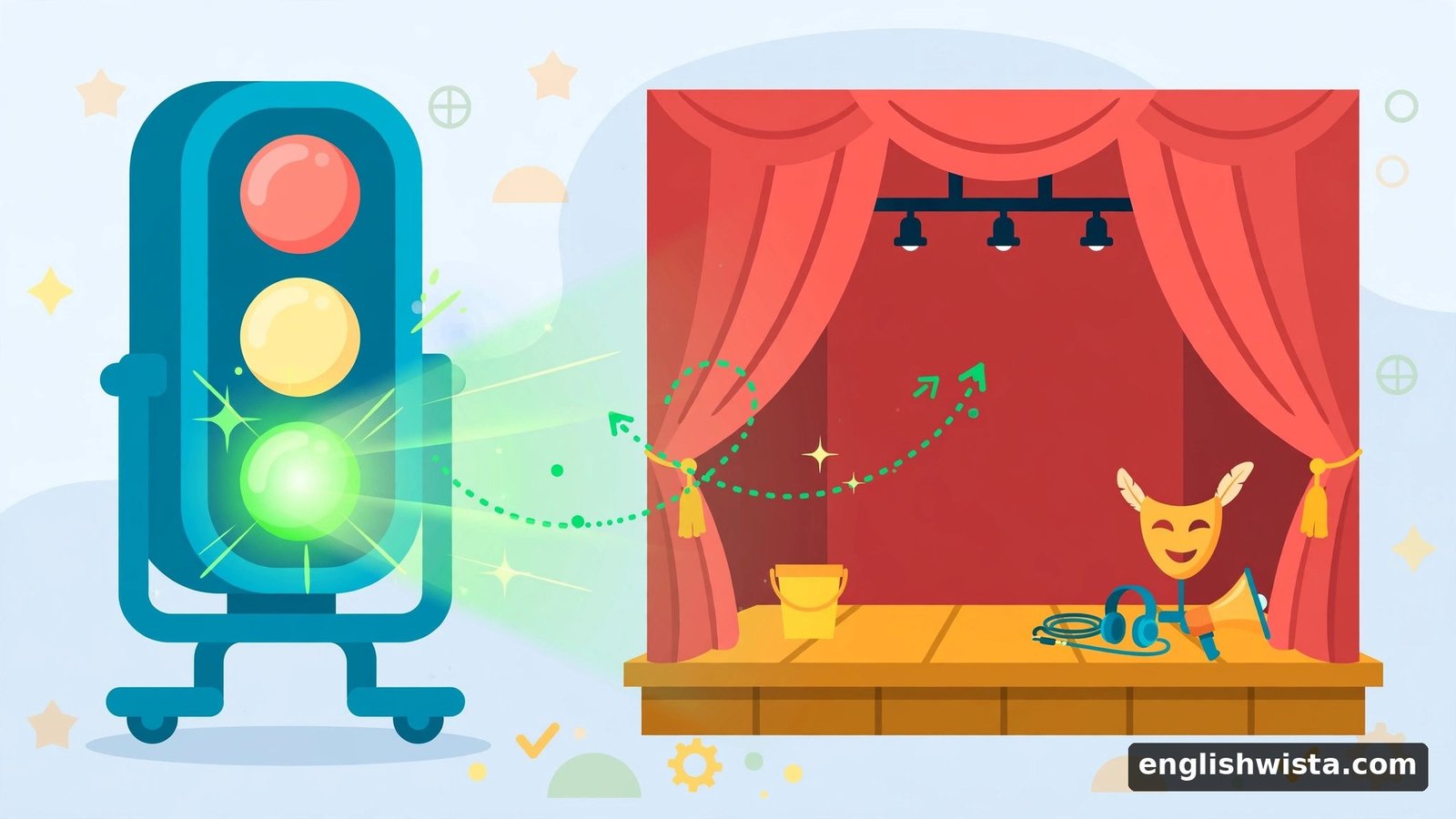
What Is the Simple Difference?
Here is the short answer you can use almost every time:
- Cue = a signal to do something (theater, music, conversation).
- Queue = a line of people or things waiting their turn.
Think of it this way: a cue tells you “go!”; a queue tells you “wait!”
Cue: A Signal
Use cue for a signal or hint that prompts action — on stage, in music, or in conversation.
- The actor missed her cue to enter. (Her signal.)
- That was my cue to leave the meeting. (The hint to act.)
- The conductor gave the cue and the music began. (The starting signal.)
- Take your cue from the host’s mood. (Follow the signal.)
If it prompts action, it is a cue.
Queue: A Waiting Line
Use queue for a line of people, vehicles, or tasks waiting in order.
- We stood in a long queue at the bank. (A waiting line.)
- Please join the queue at the counter. (Get in line.)
- The printer has three jobs in the queue. (Waiting tasks.)
- He jumped the queue and everyone complained. (Cut the line!)
If it involves waiting your turn, it is a queue.
The Easy Trick to Remember
Here is a trick that never fails. Look at the spelling:
- Queue → the ueue looks like a line of people standing one behind another!
- Cue → short and quick, like a quick signal.
Try it:
- “Wait in the queue.” — a line of people! Correct!
- “That’s my cue!” — a signal! Correct!
Long line of letters = queue (line). Short word = cue (signal). That is the whole secret!
Cue vs Queue in Example Sentences
Let us look at real-life pairs side by side:
- She waited for her cue. / She waited in the queue.
- His joke was the cue for laughter. / His joke made the queue laugh.
- The DJ took his cue from the crowd. / The crowd formed a queue at the door.
In each pair, cue = signal and queue = line.
Common Mistakes to Avoid
Mistake 1: “Cue” for a waiting line.
- Wrong: “Stand in the cue, please.”
- Right: “Stand in the queue, please.” (A line!)
Mistake 2: “Queue” for a signal.
- Wrong: “That was my queue to speak.”
- Right: “That was my cue to speak.” (A signal!)
Mistake 3: Confusing with “cue stick.” A cue is also the stick used in pool/billiards — same spelling as the signal. (“Cue” the ball!) It has nothing to do with queues.
Frequently Asked Questions
Are they pronounced the same? Yes — both sound like “kyoo.” Only spelling and meaning differ, which is why the visual trick helps.
Is “queue” British English? Mostly — British speakers say queue where Americans usually say line. But “queue” for print jobs and playlists is universal in tech.
Can “queue” be a verb? Yes! “We queued for an hour.” And cue is a verb too: “The music cued his entrance.”
What does “on cue” mean? Exactly on time, as if signaled: “The rain started right on cue.” Always spelled cue!

Mini Quiz: Test Yourself
Choose cue or queue for each sentence.
- 1. Please join the _____ at the ticket counter.
- 2. The lights dimming was our _____ to sit down.
- 3. There are five songs in the _____.
- 4. Take your _____ from the teacher’s nod.
- 5. He waited in the _____ for two hours.
Answers: 1. queue (waiting line) 2. cue (signal) 3. queue (waiting list) 4. cue (signal) 5. queue (line)
Quick Recap
- Cue = a signal to act (short word, quick signal).
- Queue = a waiting line (long word looks like a line).
- Both are verbs too: cue (signal), queue (line up).
- “On cue” = right on time, always spelled cue.
- British “queue” = American “line.”
Conclusion
So, cue or queue? Now you know: a cue signals “go!” and a queue means “wait your turn.” With the spelling trick in your pocket, you will never mix them up again. Keep practicing with real sentences, and soon the right word will come to you automatically!